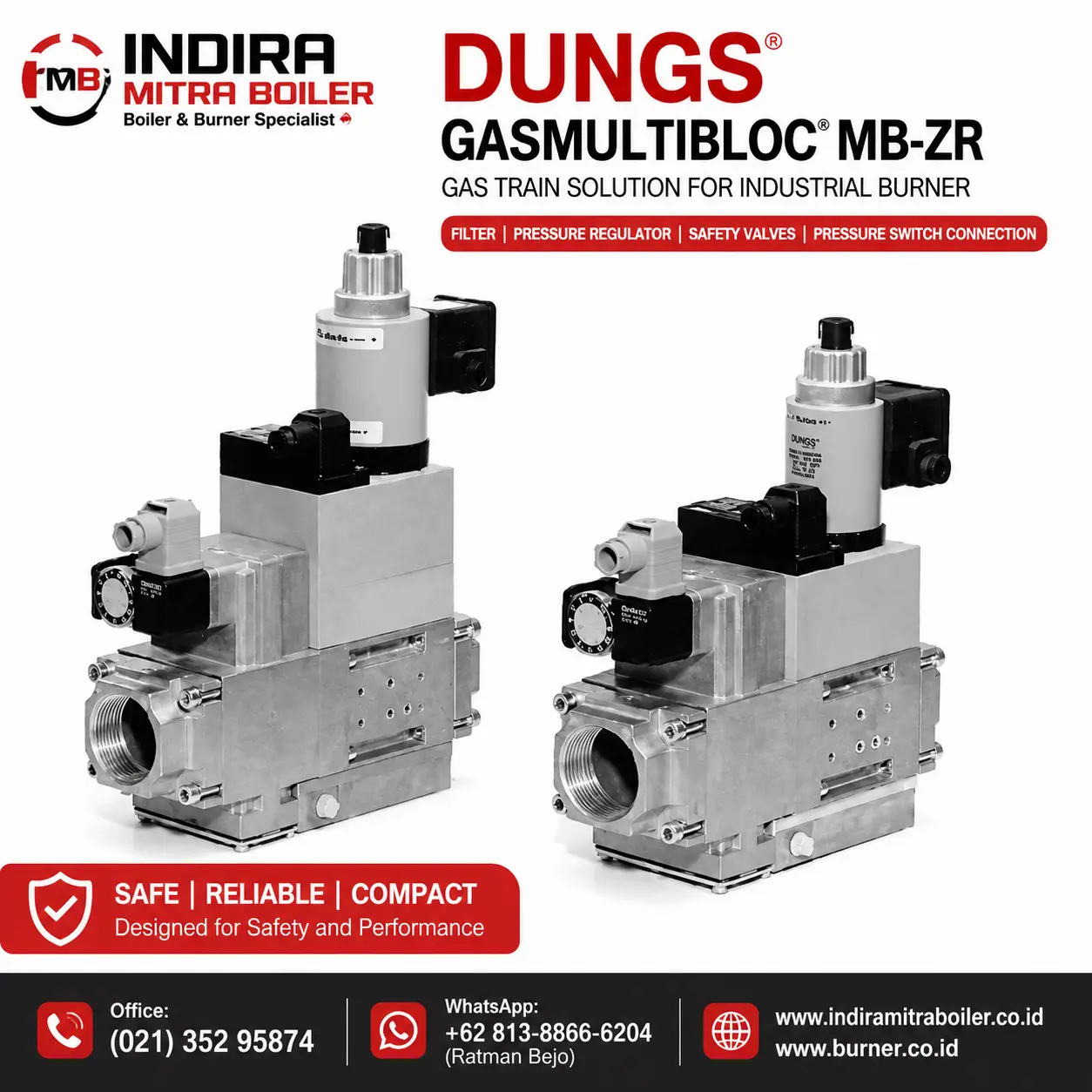
DUNGS Gas MultiBloc MB-ZR: Rangkaian Katup Gas, Regulator, Filter, dan Sakelar Tekanan
1. Pendahuluan
DUNGS GasMultiBloc® MB-ZR adalah sistem pengaman gas dan pengaturan tekanan yang ringkas , dirancang untuk peralatan pembakaran industri dan komersial. Sistem ini menggabungkan beberapa komponen penting dari rangkaian gas pembakar ke dalam satu rakitan yang ringkas, termasuk filter gas berlubang halus, regulator tekanan, katup pengaman, dan koneksi sakelar tekanan .
Desain terintegrasi ini memberikan solusi praktis untuk peralatan berbahan bakar gas yang membutuhkan kontrol tekanan gas yang andal, pemutusan gas otomatis, dan pengoperasian pembakar yang aman . Dengan mengintegrasikan berbagai fungsi ke dalam satu unit, GasMultiBloc dapat membantu menyederhanakan instalasi rangkaian gas sekaligus mengurangi jumlah komponen, fitting, dan sambungan pipa individual.
Aplikasi DUNGS GasMultiBloc MB-ZR
DUNGS GasMultiBloc MB-ZR dirancang untuk berbagai aplikasi pembakaran, pemanasan, dan pembangkitan panas berbahan bakar gas di mana pengaturan tekanan gas yang andal, pemutus keselamatan otomatis, dan pasokan bahan bakar yang terkontrol diperlukan.
Desainnya yang ringkas mengintegrasikan fungsi-fungsi penting dari rangkaian gas, sehingga cocok untuk aplikasi di mana ruang instalasi, keandalan sistem, dan konfigurasi rangkaian gas yang disederhanakan menjadi penting.
Aplikasi tipikal meliputi:
- Industrial Gas Burners – Used as an integrated component of the gas train for burners installed on industrial boilers, furnaces, ovens, dryers, and process-heating equipment.
- Commercial Gas Burners – Suitable for commercial heating equipment requiring compact gas pressure regulation and safety shut-off valves.
- Steam Boilers – Used in gas-fired steam boiler burner systems to regulate gas pressure and provide reliable gas shut-off during burner operation.
- Hot Water Boilers – Supports controlled gas supply for burners used in industrial and commercial hot water generation systems.
- Thermal Oil Heaters – Can be integrated into gas-fired thermal oil heater systems where stable gas pressure and reliable burner safety are required.
- Industrial Furnaces – Suitable for gas-fired furnaces used in high-temperature heating, heat treatment, and industrial manufacturing processes.
- Industrial Ovens – Can be used with gas burners for powder coating ovens, paint curing ovens, food-processing ovens, and other industrial heating chambers.
- Industrial Dryers – Provides gas regulation and safety functions for burner systems used in drying equipment where stable heat input is important.
- Heat-Generation Plants – Can serve as part of the gas train for industrial heat-generation equipment requiring integrated pressure regulation and automatic gas shut-off.
- Industrial Heating Systems – Suitable for various gas-fired heating applications where a compact and reliable gas-train solution is required.
DUNGS GasMultiBloc for Industrial Burner Systems
In a typical industrial burner gas train, the DUNGS GasMultiBloc MB-ZR is installed between the gas supply and the burner. It integrates several important gas-control functions into a compact assembly, helping simplify the overall gas-train configuration.
A simplified gas flow arrangement is:
Gas Supply → DUNGS GasMultiBloc → Burner → Combustion Chamber
Inside the GasMultiBloc, the gas can pass through the integrated fine-mesh filter, pressure regulator, and safety shut-off valves before reaching the burner. Depending on the selected configuration, additional components such as minimum/maximum gas pressure switches, measuring points, flow restrictors, valve-position monitoring, and other safety accessories can also be incorporated.
For a two-stage burner, the valve configuration can be selected according to the required gas-flow characteristics. Certain versions provide fast opening, while others provide slow opening with partial-volume and main-volume adjustment.
GasMultiBloc Selection
Memilih DUNGS GasMultiBloc MB-ZR yang tepat membutuhkan lebih dari sekadar mencocokkan ukuran sambungan pipa. Rangkaian gas harus dicocokkan dengan kapasitas pembakar, karakteristik bahan bakar, tekanan gas, aliran gas yang dibutuhkan, sistem kelistrikan, dan urutan pengoperasian pembakar .
Parameter seleksi utama meliputi:
- Kapasitas Pembakar – Masukan panas pembakar menentukan kapasitas aliran gas yang dibutuhkan oleh GasMultiBloc.
- Jenis Gas – Konfirmasikan apakah sistem menggunakan gas alam, LPG gas, atau media gas netral lain yang disetujui.
- Tekanan Masukan Gas – Periksa tekanan yang tersedia dari pasokan gas hulu untuk memastikan tekanan tersebut berada dalam kisaran operasi yang diizinkan.
- Tekanan Keluaran yang Diperlukan – Regulator harus mampu memberikan tekanan gas yang dibutuhkan oleh pembakar pada laju pembakaran yang diperlukan.
- Laju Aliran Gas – Konsumsi gas minimum dan maksimum harus dipertimbangkan, khususnya untuk aplikasi pembakar dua tahap atau modulasi.
- Ukuran Sambungan Pipa – Sambungan GasMultiBloc harus sesuai dengan pipa saluran gas dan persyaratan instalasi yang ada.
- Tegangan Listrik – Katup solenoid dan sakelar tekanan harus kompatibel dengan catu daya listrik panel kontrol pembakar.
- Konfigurasi Katup – Pilih konfigurasi pembukaan cepat atau pembukaan lambat yang sesuai dengan urutan penyalaan dan pengoperasian pembakar.
- Konfigurasi Sakelar Tekanan – Tentukan apakah diperlukan pemantauan tekanan gas minimum, maksimum, atau lainnya.
- Mode Operasi Pembakar – Periksa apakah pembakar beroperasi ON/OFF, dua tahap, atau modulasi , karena ini memengaruhi konfigurasi jalur gas yang dibutuhkan.
Mengapa Penentuan Ukuran DUNGS GasMultiBloc yang Tepat Itu Penting?
Memilih DUNGS GasMultiBloc MB-ZR yang tepat sangat penting untuk memastikan pengoperasian burner gas industri yang andal, stabil, dan aman. Pemilihan GasMultiBloc tidak hanya berdasarkan ukuran sambungan pipa. Seluruh rangkaian gas burner dan sistem pembakaran harus dievaluasi.
Pemilihan GasMultiBloc yang salah dapat mengakibatkan:
- Penurunan tekanan gas yang berlebihan
- Aliran gas tidak mencukupi
- Pengoperasian pembakar yang tidak stabil
- Masalah pengapian
- Laju pembakaran pembakar yang salah
- Masalah pengaturan tekanan
- Ketidaksesuaian dengan sistem kontrol pembakar
- Kesulitan meningkat selama proses komisioning.
Oleh karena itu, model yang tepat harus disesuaikan dengan kapasitas pembakar, jenis gas, tekanan masuk gas, tekanan keluar yang dibutuhkan, laju aliran gas, ukuran sambungan, tegangan listrik, konfigurasi sakelar tekanan, dan mode operasi pembakar .
Informasi Penting untuk Penggantian
Untuk penggantian DUNGS GasMultiBloc , disarankan untuk memeriksa unit yang ada sebelum memesan. Cara termudah untuk mengidentifikasi pengganti yang sesuai adalah dengan memberikan foto yang jelas dari pelat nama atau nomor model DUNGS .
Informasi berikut ini juga perlu diverifikasi:
- Nomor model DUNGS yang ada
- Pabrikan dan model pembakar
- Kapasitas pembakar
- Jenis gas
- Tekanan masuk gas
- Tekanan keluaran yang dibutuhkan
- Konsumsi gas maksimum
- Ukuran sambungan gas
- Tegangan listrik
- Konfigurasi katup
- Konfigurasi sakelar tekanan
- Mode pengoperasian pembakar
Informasi ini memungkinkan GasMultiBloc pengganti untuk dicocokkan dengan benar dengan burner industri dan sistem saluran gas yang ada , sehingga mengurangi risiko masalah kompatibilitas selama instalasi dan pengoperasian.
DUNGS GasMultiBloc untuk Rangkaian Gas Pembakar Industri
DUNGS GasMultiBloc MB-ZR merupakan bagian penting dari sistem pasokan dan keamanan gas antara sumber gas dan pembakar.
Susunan tipikal dapat digambarkan sebagai:
Pasokan Gas → DUNGS GasMultiBloc → Pembakar → Ruang Pembakaran
Tergantung pada konfigurasi yang dipilih, GasMultiBloc dapat menggabungkan fungsi-fungsi seperti penyaringan gas, pengaturan tekanan, penghentian pengaman, pemantauan tekanan, dan penyesuaian aliran gas .
Regulator tekanan membantu menjaga tekanan gas hilir yang dibutuhkan, sementara katup pengaman menyediakan penghentian aliran gas yang terkontrol sesuai dengan urutan pengoperasian dan keselamatan pembakar.
Konfigurasi MB-ZR yang berbeda dapat memberikan karakteristik pembukaan katup yang berbeda , termasuk pengaturan pembukaan cepat atau pembukaan lambat. Versi tertentu juga dapat menggabungkan penyesuaian volume parsial dan volume utama , sehingga sistem ini cocok untuk berbagai kebutuhan pengoperasian pembakar.
Aplikasi pada Pembakar Industri
GasMultiBloc dapat diintegrasikan ke dalam peralatan berbahan bakar gas seperti:
- Pembakar gas industri
- Ketel uap
- Pemanas air panas
- Pemanas minyak termal
- Tungku industri
- Oven industri
- Sistem pengeringan
- Sistem pemanas aspal
- Pembangkit listrik tenaga panas
- Peralatan pemanas industri lainnya
Untuk aplikasi industri, ukuran dan konfigurasi yang tepat sangat penting untuk mencapai tekanan gas yang stabil, pengoperasian pembakar yang andal, penyalaan yang terkontrol, dan kinerja sistem keselamatan yang memadai .
PT Indira Mitra Boiler – DUNGS GasMultiBloc
PT Indira Mitra Boiler memasok DUNGS GasMultiBloc MB-ZR, suku cadang burner gas, dan komponen pembakaran industri untuk aplikasi di seluruh Indonesia.
Tim teknik kami dapat membantu dalam identifikasi model, pemilihan pengganti, konfigurasi jalur gas, pengecekan kompatibilitas, dan dukungan teknis untuk sistem boiler dan burner industri.
Untuk permintaan penggantian, pelanggan dapat mengirimkan nomor model DUNGS, model burner, jenis gas, tekanan gas, kapasitas burner, dan foto yang jelas dari pelat nama GasMultiBloc yang ada . Informasi ini akan membantu menentukan konfigurasi DUNGS GasMultiBloc MB-ZR yang sesuai untuk aplikasi tersebut.
2. Apa itu DUNGS GasMultiBloc?
DUNGS GasMultiBloc® MB-ZR adalah sistem keselamatan gas dan pengaturan tekanan modular yang dirancang untuk peralatan pembakaran industri dan komersial. Sistem ini menggabungkan beberapa komponen penting dari rangkaian gas ke dalam satu rakitan kompak, membantu menyederhanakan pemasangan sekaligus menyediakan pasokan gas yang terkontrol dan andal ke pembakar.
GasMultiBloc dapat mengintegrasikan fungsi-fungsi berikut:
- Filter gas berlubang halus – Membantu menjebak kotoran dan partikel dari pasokan gas sebelum mencapai komponen hilir.
- Regulator tekanan gas – Mengontrol dan mempertahankan tekanan gas hilir yang dibutuhkan untuk pembakar.
- Katup pengaman V1 – Menyediakan pemutusan aliran gas otomatis sebagai bagian dari sistem keselamatan pembakar.
- Katup pengaman V2 – Menyediakan fungsi pemutus aliran gas pengaman kedua dengan karakteristik pembukaan yang bergantung pada model yang dipilih.
- Koneksi sakelar tekanan – Memungkinkan pemantauan tekanan gas menggunakan sakelar tekanan yang kompatibel.
- Titik pengukuran – Menyediakan akses untuk memeriksa tekanan gas selama instalasi, pengoperasian awal, dan pemeliharaan.
- Pengaturan volume utama – Memungkinkan pengaturan karakteristik aliran gas utama pada konfigurasi yang berlaku.
- Pengaturan volume parsial – Memberikan pengaturan aliran gas tambahan selama pengoperasian api kecil atau penyalaan pada model tertentu.
- Aksesori opsional – Desain modular memungkinkan penambahan komponen keselamatan dan pemantauan sesuai dengan aplikasinya.
Konfigurasi Pembukaan Cepat dan Pembukaan Lambat
Salah satu fitur penting dari DUNGS GasMultiBloc MB-ZR adalah ketersediaan karakteristik bukaan katup yang berbeda.
Tergantung pada konfigurasi yang dipilih, V1 adalah katup pengaman yang menutup cepat , sedangkan V2 dapat dikonfigurasi untuk membuka cepat atau lambat .
Konfigurasi bukaan cepat memungkinkan aliran gas mencapai kondisi operasi yang dibutuhkan dengan cepat. Konfigurasi bukaan lambat memberikan peningkatan aliran gas yang lebih terkontrol, yang dapat berguna selama penyalaan pembakar dan transisi ke pembakaran normal.
Sebagai contoh, beberapa versi MB-ZR tertentu tersedia dengan V2 bukaan cepat , sementara versi lainnya menggunakan V2 bukaan lambat dengan pengaturan volume parsial dan volume utama .
Konfigurasi modular ini memungkinkan GasMultiBloc disesuaikan dengan berbagai kebutuhan pembakar, termasuk sistem pembakar gas ON/OFF dan dua tahap .
Cara Kerja GasMultiBloc
Susunan aliran gas yang disederhanakan adalah:
Pasokan Gas → Filter → Regulator Tekanan → Katup Pengaman V1 → Katup Pengaman V2 → Pembakar
Filter terintegrasi membantu melindungi komponen pengontrol gas dari kontaminasi. Regulator kemudian menyesuaikan tekanan gas ke tingkat pengoperasian yang dibutuhkan, sementara katup pengaman mengontrol pasokan gas sesuai dengan urutan keselamatan pembakar.
Selama penyalaan awal pembakar, katup gas dikendalikan oleh sistem manajemen atau kontrol pembakar. Konfigurasi katup yang dipilih menentukan seberapa cepat aliran gas terbentuk dan, jika berlaku, bagaimana aliran gas dibatasi selama penyalaan atau operasi api kecil.
Hal ini menjadikan DUNGS GasMultiBloc MB-ZR cocok untuk sistem pembakaran industri yang membutuhkan desain ringkas, pengaturan tekanan gas, penghentian otomatis untuk keselamatan, dan aliran gas yang terkontrol .
Aplikasi tipikal meliputi pembakar gas industri, boiler uap, boiler air panas, pemanas minyak termal, tungku, oven, pengering, dan sistem pemanas berbahan bakar gas lainnya .
3. Fungsi Utama dari DUNGS GasMultiBloc
Tujuan utama DUNGS GasMultiBloc MB-ZR adalah untuk menyediakan solusi terintegrasi untuk keselamatan gas, pengaturan tekanan, filtrasi, dan pasokan gas terkontrol dalam sistem pembakaran.
Pada instalasi pembakar gas standar, gas harus melewati beberapa komponen kontrol dan pengaman sebelum mencapai pembakar. Susunan yang disederhanakan adalah:
Pasokan Gas → Filter → Pengaturan Tekanan → Pengaman Mati → Pembakar
DUNGS GasMultiBloc menggabungkan beberapa fungsi ini menjadi satu rakitan yang ringkas. Hal ini membantu mengurangi jumlah komponen terpisah yang dibutuhkan dalam rangkaian gas pembakar sekaligus memberikan solusi praktis untuk aplikasi pembakaran industri dan komersial.
Keunggulan dari GasMultiBloc Terintegrasi
Penggunaan GasMultiBloc terintegrasi dapat memberikan beberapa manfaat praktis:
- Instalasi ringkas – Berbagai fungsi kontrol gas digabungkan menjadi satu unit.
- Penyederhanaan perpipaan – Membutuhkan lebih sedikit komponen dan sambungan individual.
- Mengurangi waktu pemasangan – Konfigurasi yang ringkas dapat menyederhanakan perakitan rangkaian gas.
- Perawatan lebih mudah – Komponen pengontrol gas penting terkonsentrasi dalam satu unit.
- Pengaturan tekanan terintegrasi – Regulator ini membantu menjaga tekanan gas pembakar yang dibutuhkan.
- Penghentian aliran gas yang andal – Katup pengaman memberikan penghentian pasokan gas yang terkontrol.
- Konfigurasi fleksibel – Berbagai konfigurasi katup dan aksesori dapat dipilih sesuai dengan aplikasi pembakar.
4. Filter Gas / Perangkap Kotoran
DUNGS GasMultiBloc MB-ZR dilengkapi dengan saringan berlubang halus yang berfungsi sebagai filter gas atau perangkap kotoran.
Tujuan utama filter ini adalah untuk membantu mencegah partikel asing masuk ke regulator tekanan, katup solenoid, rangkaian gas pembakar, dan peralatan pembakaran hilir .
Kontaminasi dapat masuk ke dalam sistem perpipaan gas selama pemasangan, pemeliharaan, modifikasi pipa, korosi, atau proses mekanis lainnya. Jika partikel mencapai komponen katup atau regulator yang sensitif, partikel tersebut dapat memengaruhi pergerakan katup, pengaturan tekanan, atau kinerja penyegelan.
Oleh karena itu, filter terintegrasi ini memberikan tahap perlindungan pertama yang penting untuk sistem pengendalian gas di hilir.
Perawatan Filter
Kondisi filter harus diperiksa sebagai bagian dari program perawatan burner. Filter yang terkontaminasi dapat meningkatkan kehilangan tekanan dan berpotensi memengaruhi pasokan gas ke burner.
Perawatan harus mengikuti petunjuk pabrikan DUNGS yang berlaku dan persyaratan sistem gas yang terpasang.
Sebelum melakukan perawatan, pasokan gas harus diisolasi dengan aman dan sistem harus ditangani oleh personel yang berkualifikasi.
5. Regulator Tekanan Gas
Komponen penting lainnya dari DUNGS GasMultiBloc MB-ZR adalah regulator tekanan gas terintegrasi .
Regulator mengontrol tekanan gas hilir yang disuplai ke pembakar. Tekanan gas yang stabil sangat penting karena kinerja pembakar bergantung pada hubungan antara tekanan gas, aliran gas, udara pembakaran, dan penyesuaian pembakar .
Jika tekanan gas berada di luar kisaran operasi yang dibutuhkan, pembakar mungkin mengalami masalah seperti:
- Api yang tidak stabil
- Kapasitas pembakar tidak tepat
- Kesulitan pengapian
- Penyesuaian pembakaran yang buruk
- Penurunan tekanan yang berlebihan
- Aliran gas tidak mencukupi
Regulator tekanan GasMultiBloc menggunakan prinsip pengaturan proporsional dan dirancang sesuai dengan persyaratan DIN EN 88 Kelas A Grup 2 yang berlaku untuk konfigurasi yang relevan.
Regulator ini dikompensasi untuk tekanan sisa dan memberikan segel kedap bocor ketika sistem gas dimatikan melalui katup V1 .
Penyesuaian Tekanan
Tekanan keluaran yang dibutuhkan bergantung pada desain pembakar dan kondisi pengoperasian. Oleh karena itu, GasMultiBloc tidak boleh disetel hanya berdasarkan tekanan pasokan gas yang tersedia.
Saat memilih model yang tepat, hal-hal berikut perlu dipertimbangkan:
- Jenis gas
- Tekanan masuk gas
- Tekanan keluaran yang dibutuhkan
- Kapasitas pembakar
- Konsumsi gas
- Konfigurasi regulator
- Mode pengoperasian pembakar
Pegas setpoint terpasang secara permanen dalam konfigurasi yang ditentukan, sehingga rentang tekanan yang dibutuhkan harus dipertimbangkan saat memilih model GasMultiBloc yang tepat.
6. Katup Pengaman V1
Katup pengaman utama pertama di GasMultiBloc diberi kode V1 .
V1 berfungsi sebagai katup pengaman penutup dan dirancang sesuai dengan DIN EN 161 Kelas A Grup 2 untuk konfigurasi produk yang berlaku.
Fungsi utamanya adalah untuk memberikan penghentian pasokan gas yang andal ketika pembakar dimatikan atau ketika kondisi keselamatan mengharuskan pasokan gas dimatikan.
V1 dirancang dengan karakteristik penutupan cepat , memungkinkan pasokan gas dihentikan dengan cepat ketika sistem pengaman memerintahkan katup untuk menutup.
V1 dalam Urutan Keamanan Pembakar
Dalam sistem pembakar tipikal, V1 beroperasi sebagai bagian dari keseluruhan rangkaian keselamatan pembakar.
Urutan yang disederhanakan dapat direpresentasikan sebagai:
Pengecekan Tekanan Gas → Perintah Menyalakan Pembakar → Kontrol Katup → Pengapian → Verifikasi Nyala Api → Pengoperasian Pembakar
Jika sistem kontrol pembakar mendeteksi kondisi yang tidak aman, katup gas diperintahkan untuk menutup.
Kondisi keselamatan yang mungkin terjadi dapat meliputi:
- Tekanan gas tidak mencukupi
- Tekanan gas berlebihan
- Kegagalan nyala api
- Kesalahan kontrol pembakar
- Kesalahan tekanan udara
- Pengaktifan pengunci pengaman
- Penghentian darurat
Urutan pastinya bergantung pada sistem manajemen pembakar, pengontrol pembakar, sakelar tekanan, sistem pengaman api, dan desain pembakar secara keseluruhan .
Oleh karena itu, V1 harus dianggap sebagai salah satu komponen dari sistem keselamatan pembakar yang lengkap, bukan sebagai pengontrol pembakar yang independen.
Pentingnya V1 untuk Pembakar Industri
Untuk pembakar industri, penghentian aliran gas yang andal sangat penting karena pembakar dapat beroperasi pada input bahan bakar yang relatif tinggi dan dalam kondisi produksi yang menuntut.
Katup pengaman V1 memberikan lapisan perlindungan penting dengan mengontrol pasokan gas sesuai dengan urutan keselamatan pembakar.
Pemasangan, pengkabelan, pengujian, dan pengoperasian yang benar sangat penting untuk memastikan bahwa katup beroperasi dengan benar dalam keseluruhan sistem aliran gas.
7. Katup Pengaman V2
Katup pengaman utama kedua pada DUNGS GasMultiBloc MB-ZR diberi kode V2 . Bersama dengan V1, katup ini merupakan bagian penting dari sistem keselamatan gas dan mengontrol pasokan gas ke pembakar.
Karakteristik pembukaan V2 bergantung pada konfigurasi GasMultiBloc tertentu . Tersedia berbagai versi untuk mengakomodasi berbagai kebutuhan penyalaan dan pengoperasian burner.
Konfigurasi umum meliputi:
| Versi GasMultiBloc | Karakteristik Pembukaan V2 | Pembatasan Volume |
|---|---|---|
| MB-ZR | Buka cepat | Tidak ada pembatas volume parsial |
| MB-ZRD | Buka cepat | Pembatas volume parsial dan utama |
| MB-ZRDLE | Pembukaan yang lambat | Pembatas volume parsial dan utama |
| MB-ZRLE | Pembukaan yang lambat | Pembatasan volume utama |
Fleksibilitas ini memungkinkan DUNGS GasMultiBloc untuk disesuaikan dengan berbagai desain burner dan kebutuhan aliran gas.
Sebagai contoh, pembakar yang membutuhkan pembentukan gas yang cepat dapat menggunakan konfigurasi bukaan cepat, sedangkan aplikasi yang membutuhkan penyalaan terkontrol dapat menggunakan konfigurasi bukaan lambat.
Model yang tepat harus selalu dipilih sesuai dengan spesifikasi pabrikan burner, tekanan gas, kapasitas burner, urutan penyalaan, dan desain rangkaian gas lengkap .
8. Katup Gas Pembukaan Cepat dan Pembukaan Lambat
Karakteristik pembukaan katup gas sangat penting terutama selama proses penyalaan dan pengaktifan pembakar .
Katup V2 yang membuka cepat memungkinkan katup gas mencapai posisi operasinya dengan cepat. Konfigurasi ini mungkin cocok untuk sistem pembakar di mana karakteristik aliran gas yang dibutuhkan dapat ditetapkan dengan cepat selama urutan penyalaan.
Sebaliknya, katup V2 yang terbuka perlahan memungkinkan aliran gas meningkat secara bertahap. Hal ini memberikan kontrol yang lebih besar atas pasokan gas awal dan dapat berguna untuk pembakar yang membutuhkan urutan penyalaan yang terkontrol .
Perbandingan yang disederhanakan adalah:
Buka Cepat
Perintah Katup → Peningkatan Aliran Gas Cepat → Pengoperasian Pembakar
Pembukaan Lambat
Perintah Katup → Peningkatan Aliran Gas Terkontrol → Pengapian → Pengoperasian Pembakar
Untuk pembakar industri, pemasukan gas yang terkontrol selama penyalaan dapat menjadi bagian penting dari keseluruhan desain sistem pembakaran.
Namun, karakteristik bukaan katup tidak boleh dipilih secara independen. Konfigurasi yang tepat harus diselaraskan dengan kepala pembakar, sistem pengapian, udara pembakaran, pengontrol pembakar, sistem pengaman api, dan tekanan gas .
9. Pembatas Volume Utama dan Pembatas Volume Parsial
Konfigurasi DUNGS GasMultiBloc MB-ZR tertentu menggabungkan pembatas volume utama dan pembatas volume parsial pada katup V2.
Fungsi penyesuaian ini memungkinkan karakteristik aliran gas disesuaikan dengan kebutuhan pembakar.
Penyesuaian Volume Sebagian
Pengaturan volume parsial sangat relevan dengan tahap awal atau tahap pembakaran rendah pada pengoperasian burner.
Hal ini dapat membantu mengontrol jumlah gas yang disuplai selama pembukaan awal katup, tergantung pada konfigurasi GasMultiBloc tertentu.
Ini berguna untuk sistem pembakar di mana aliran gas awal perlu dikontrol sebelum pembakar beralih ke laju pembakaran yang lebih tinggi.
Penyesuaian Volume Utama
Penyesuaian volume utama terkait dengan rentang aliran gas operasi yang lebih tinggi atau normal.
Alat ini dapat digunakan selama pengoperasian awal pembakar untuk menentukan aliran gas yang dibutuhkan sesuai dengan spesifikasi pabrikan pembakar.
Tujuannya adalah untuk memastikan bahwa pembakar menerima jumlah bahan bakar yang sesuai untuk masukan panas yang dibutuhkan sambil mempertahankan kondisi pembakaran yang tepat.
Pentingnya Penyesuaian yang Tepat
Pengaturan aliran gas harus dilakukan oleh teknisi pembakaran yang berkualifikasi menggunakan peralatan pengukuran dan analisis pembakaran yang sesuai.
Penyesuaian tersebut harus mempertimbangkan:
- Tekanan gas
- Kapasitas pembakar
- Konsumsi gas
- Udara pembakaran
- Stabilitas nyala api
- Tingkat O₂
- tingkat CO
- Tingkat tembakan yang dibutuhkan
- Spesifikasi pabrikan burner
Pengaturan aliran gas yang tidak tepat dapat memengaruhi kinerja pembakar dan keselamatan pembakaran. Oleh karena itu, GasMultiBloc harus dipasang sebagai bagian dari sistem pembakar lengkap.
10. Penundaan Pembukaan Hidraulik
Konfigurasi DUNGS GasMultiBloc tertentu menggabungkan mekanisme penundaan pembukaan hidraulik.
Tujuan dari penundaan pembukaan adalah untuk memberikan peningkatan aliran gas yang lebih terkontrol selama proses penyalaan pembakar.
Alih-alih membiarkan katup langsung bergerak ke posisi operasi penuhnya, karakteristik pembukaan dapat memberikan transisi terkontrol selama urutan pengapian.
Konsep pengoperasian yang disederhanakan adalah:
Pembakar Menyala → Katup Diaktifkan → Pembukaan Terkendali → Aliran Gas Meningkat → Api Terbentuk → Operasi Normal
Hal ini dapat sangat berguna dalam aplikasi pembakar di mana pemasukan gas yang terkontrol diperlukan selama penyalaan.
Perilaku pembukaan dan rentang penyesuaian yang sebenarnya bergantung pada model dan konfigurasi MB-ZR tertentu . Oleh karena itu, dokumentasi teknis pabrikan harus dikonsultasikan sebelum melakukan penyesuaian apa pun.
Fungsi penundaan pembukaan hidraulik juga harus dipertimbangkan bersama dengan pengontrol pembakar, sistem pengapian, pasokan udara pembakaran, dan sistem pemantauan nyala api.
11. Koneksi Sakelar Tekanan
DUNGS GasMultiBloc MB-ZR menyediakan koneksi untuk sakelar tekanan gas yang kompatibel , memungkinkan tekanan gas dipantau sebagai bagian dari sistem keselamatan dan kontrol pembakar.
Sakelar tekanan dapat digunakan untuk beberapa fungsi penting, termasuk:
- Pemantauan tekanan gas minimum
- Pemantauan tekanan gas maksimum
- Keamanan tekanan gas
- Pengunci pembakar
- Pembakar mulai diizinkan
- Deteksi kerusakan pasokan gas
Sakelar tekanan memantau tekanan gas dan mengubah kondisi kontak listriknya ketika tekanan mencapai titik pengalihan yang telah dikonfigurasi.
Sinyal tersebut kemudian dapat dihubungkan ke sistem kontrol pembakar atau sistem manajemen pembakar .
Urutan kontrol yang disederhanakan dapat direpresentasikan sebagai:
Tekanan Gas → Sakelar Tekanan → Kontrol Pembakar → Katup Gas → Pembakar
Jika kondisi tekanan gas yang dibutuhkan tidak terpenuhi, sistem kontrol pembakar dapat mencegah penyalaan pembakar atau memulai penghentian keselamatan, tergantung pada konfigurasi sistem.
Pemantauan Tekanan Gas Minimum
Saklar tekanan gas minimum dapat membantu memastikan bahwa tekanan gas yang cukup tersedia sebelum pembakar mulai bekerja.
Misalnya:
Tekanan Gas di Bawah Titik Setel → Sakelar Tekanan Aktif → Pembakar Dicegah Menyala
Hal ini dapat membantu mencegah pembakar beroperasi di luar kondisi pasokan gas yang dibutuhkan.
Pemantauan Tekanan Gas Maksimum
Saklar tekanan gas maksimum dapat memberikan fungsi keselamatan tambahan dengan memantau tekanan gas yang berlebihan.
Urutan yang disederhanakan adalah:
Tekanan Gas Melebihi Titik Setel → Sakelar Tekanan Aktif → Pembakar Mati Otomatis
Urutan pastinya bergantung pada sistem manajemen pembakar dan arsitektur keselamatan.
Pemilihan Sakelar Tekanan
Saklar tekanan yang tepat harus dipilih sesuai dengan kebutuhan:
- Rentang tekanan
- Titik peralihan
- Jenis gas
- Karakteristik listrik
- Konfigurasi koneksi
- Sistem kontrol pembakar
- Persyaratan keselamatan yang berlaku
Untuk aplikasi penggantian, model DUNGS GasMultiBloc dan jenis sakelar tekanan yang ada harus diperiksa dengan cermat sebelum memesan.
Konfigurasi sakelar tekanan yang benar sangat penting karena sakelar tekanan merupakan bagian dari sistem pengaman interlock pembakar secara keseluruhan , bukan sekadar indikator tekanan.
12. Pemantauan Tekanan Pembakar
DUNGS GasMultiBloc MB-ZR menyediakan koneksi dan titik pengukuran khusus untuk memeriksa atau memantau tekanan gas di dalam rangkaian gas pembakar. Titik pengukuran ini berguna selama instalasi, pengoperasian awal, pemecahan masalah, pemeliharaan, dan penyesuaian pembakaran .
Pengukuran tekanan gas yang akurat sangat penting karena kinerja pembakar bergantung pada hubungan antara tekanan gas, aliran gas, udara pembakaran, dan laju pembakaran pembakar .
Teknisi dapat menggunakan titik pengukuran yang telah ditentukan untuk memverifikasi tekanan gas di lokasi yang relevan, tergantung pada konfigurasi GasMultiBloc dan pengaturan instalasinya.
Pengukuran Tekanan Gas Selama Proses Pemasangan Awal
Selama proses pengoperasian awal pembakar, teknisi dapat memeriksa:
- Tekanan masuk gas
- Tekanan keluaran yang diatur
- Tekanan gas pembakar
- Tekanan gas selama penyalaan
- Tekanan gas pada api kecil
- Tekanan gas pada api besar
Susunan yang disederhanakan adalah:
Pasokan Gas → DUNGS GasMultiBloc → Pembakar
Dengan mengukur tekanan pada titik-titik yang tepat, teknisi dapat menentukan apakah jalur gas tersebut memberikan tekanan yang dibutuhkan oleh pembakar.
Penyesuaian Tekanan Gas
Pengukuran tekanan gas juga dapat digunakan saat menyesuaikan regulator tekanan dan pengaturan aliran gas .
Tujuannya adalah untuk mencapai tekanan gas yang ditentukan untuk pembakar sambil mempertahankan pembakaran yang stabil.
Tekanan gas harus diperiksa bersamaan dengan parameter pembakaran seperti:
- Oksigen (O₂)
- Karbon monoksida (CO)
- Stabilitas nyala api
- Laju pembakaran pembakar
- Pengaturan udara pembakaran
Setiap penyesuaian harus dilakukan oleh personel yang berkualifikasi menggunakan instrumen pengukuran yang sesuai dan mengikuti spesifikasi pabrikan pembakar.
Pemecahan Masalah dan Pemeliharaan
Titik pengukuran tekanan gas juga berguna saat mendiagnosis masalah pada pembakar.
Sebagai contoh, pengoperasian pembakar yang tidak normal dapat dikaitkan dengan:
- Tekanan gas rendah
- Tekanan gas berlebihan
- Fluktuasi tekanan
- Pembatasan filter
- Penyesuaian regulator yang salah
- Masalah pasokan gas
- Ukuran rangkaian gas yang salah
Membandingkan tekanan yang terukur dengan tekanan pembakar yang dibutuhkan dapat membantu teknisi mengidentifikasi apakah masalah tersebut berasal dari pasokan gas, regulator, katup gas, atau sistem pembakar.
13. Sistem Keamanan Gas Modular
Salah satu keunggulan utama DUNGS GasMultiBloc MB-ZR adalah desain modularnya .
Alih-alih menggunakan konfigurasi yang sama untuk setiap aplikasi pembakar, rangkaian gas dapat diadaptasi menggunakan aksesori dan komponen yang sesuai dengan persyaratan keselamatan gas, pemantauan tekanan, kontrol pembakar, dan instalasi yang dibutuhkan .
Tergantung pada model dan aplikasi spesifiknya, komponen tambahan mungkin meliputi:
- Katup gas pengapian
- Katup tambahan yang dikendalikan dari luar
- Sistem pengujian katup
- Sakelar tekanan gas minimum
- Sakelar tekanan gas maksimum
- Pembatas tekanan
- Sakelar batas
- Pembatas langkah penutup
- Pemantauan posisi katup
- Pemblokiran regulator untuk aplikasi gas LPG
Pendekatan modular ini memungkinkan GasMultiBloc dikonfigurasi untuk berbagai jenis pembakar gas industri, boiler, tungku, oven, pemanas minyak termal, dan peralatan pembakaran lainnya .
Konfigurasi Rangkaian Gas Fleksibel
Sistem pengaman gas standar dapat dikonfigurasi sesuai dengan urutan pembakaran yang dibutuhkan:
Pasokan Gas → Filter → Pengaturan Tekanan → Katup Pengaman → Pemantauan Tekanan → Pembakar
Perangkat keselamatan tambahan dapat dipasang jika diperlukan oleh desain pembakar atau peraturan yang berlaku.
Hal ini menjadikan GasMultiBloc sangat berguna untuk aplikasi industri di mana rangkaian gas perlu memenuhi persyaratan keselamatan dan pengendalian tertentu.
Konfigurasi aksesori yang tepat harus selalu diverifikasi terhadap model DUNGS tertentu, persyaratan pabrikan burner, dan standar lokal yang berlaku .
14. Sistem Pengujian Katup
Untuk aplikasi yang memerlukan pemantauan tambahan terhadap katup pengaman gas, sistem pengujian katup dapat diintegrasikan ke dalam rangkaian gas jika didukung oleh konfigurasi yang dipilih.
Sistem pengujian katup dirancang untuk memeriksa kekencangan atau kondisi penyegelan katup pengaman sebelum pembakar diizinkan beroperasi.
Urutan yang disederhanakan dapat direpresentasikan sebagai:
Perintah Menyalakan Pembakar → Pemeriksaan Kekencangan Katup → Verifikasi Keamanan → Menyalakan Pembakar
Jika sistem katup tidak memenuhi kondisi kekedapan yang dibutuhkan, sistem kontrol pembakar dapat mencegah pembakar melanjutkan urutan penyalaan normal.
Mengapa Pengujian Katup Itu Penting?
Katup pengaman gas merupakan komponen penting dari rangkaian gas pembakar industri. Fungsi pengujian katup memberikan lapisan pemantauan tambahan dengan memeriksa kondisi katup pengaman penutup.
Hal ini sangat relevan khususnya untuk:
- Pembakar industri berkapasitas tinggi
- Ketel uap industri
- Pemanas minyak termal besar
- Tungku industri
- Oven industri
- Sistem pemanasan proses
- Pembangkit listrik tenaga panas
Metode, urutan, dan peralatan yang dibutuhkan untuk pengujian katup bergantung pada sistem manajemen pembakar, konfigurasi GasMultiBloc, kapasitas pembakar, dan persyaratan keselamatan yang berlaku .
Integrasi dengan Sistem Manajemen Pembakar
Sistem pengujian katup tidak beroperasi secara independen dari pembakar. Sistem ini harus terintegrasi dengan benar dengan sistem manajemen pembakar atau pengontrol pengaman api .
Konsep yang umum adalah:
Katup Pengaman GasMultiBloc → Pengujian Katup → Sistem Manajemen Pembakar → Urutan Pengapian
Sistem kontrol pembakar menentukan apakah kondisi keselamatan yang dibutuhkan telah terpenuhi sebelum mengizinkan pembakar untuk beroperasi.
Oleh karena itu, pengujian katup harus dirancang dan dioperasikan sebagai bagian dari rangkaian gas pembakar dan sistem keselamatan yang lengkap , dan bukan diperlakukan sebagai komponen yang berdiri sendiri.
Verifikasi Teknik
Saat menambahkan atau mengganti sistem pengujian katup, hal-hal berikut harus diperiksa:
- Model DUNGS GasMultiBloc
- Kapasitas pembakar
- Jenis gas
- Tekanan gas
- Konfigurasi katup pengaman
- Sistem manajemen pembakar
- Urutan pembuktian yang diperlukan
- Konfigurasi sakelar tekanan
- Pasokan listrik
- Standar keselamatan yang berlaku
Konfigurasi yang tepat membantu memastikan bahwa DUNGS GasMultiBloc MB-ZR beroperasi dengan benar sebagai bagian dari sistem keselamatan pembakar industri yang lengkap.
15. Aplikasi DUNGS GasMultiBloc MB-ZR
DUNGS GasMultiBloc MB-ZR dirancang untuk berbagai sistem pembakaran dan pemanasan berbahan bakar gas di mana pengaturan tekanan gas yang andal, penghentian otomatis untuk keselamatan, penyaringan, dan pasokan bahan bakar yang terkontrol diperlukan.
Ketel Uap Industri
GasMultiBloc dapat diintegrasikan ke dalam sistem pembakar gas untuk boiler uap industri . Regulator tekanan terintegrasi membantu mempertahankan tekanan gas yang dibutuhkan, sementara katup pengaman menyediakan penghentian aliran gas yang terkontrol sesuai dengan urutan keselamatan pembakar.
Untuk aplikasi boiler, pemilihan yang tepat harus mempertimbangkan kapasitas pembakar, konsumsi gas, tekanan gas masuk, tekanan gas pembakar yang dibutuhkan, dan mode operasi pembakar .
Ketel Air Panas
Gas-fired hot water boilers can use the GasMultiBloc as part of the burner gas train. The unit provides gas regulation and safety functions while maintaining a compact installation.
It can be applied to industrial heating systems where stable burner operation is required to maintain the desired hot-water temperature.
Thermal Oil Heaters
For gas-fired thermal oil heaters, the DUNGS GasMultiBloc can be installed as part of the burner gas train.
Stable gas pressure is important because the burner must provide consistent heat input to the thermal oil system. The GasMultiBloc can therefore form part of the gas regulation and safety system between the gas supply and burner.
Industrial Furnaces
Industrial furnaces require reliable combustion control because variations in gas supply can influence furnace temperature, heating performance, and process consistency.
The GasMultiBloc can be used with gas burners installed on heat-treatment furnaces, process furnaces, and other industrial combustion equipment.
Industrial Ovens
Gas burners used in industrial ovens can utilize the GasMultiBloc for controlled and safe gas supply.
Typical applications include:
- Powder coating ovens
- Paint curing ovens
- Industrial heating ovens
- Food-processing ovens
- Process heating ovens
The appropriate GasMultiBloc configuration depends on the burner capacity and required gas-control sequence.
Industrial Dryers
Gas-fired industrial dryers can use the DUNGS GasMultiBloc as part of their burner gas train.
Stable gas pressure and controlled fuel flow are important for maintaining consistent drying temperatures and process conditions.
Applications can include:
- Food dryers
- Agricultural product dryers
- Industrial material dryers
- Wood dryers
- Process dryers
Asphalt Heating Systems
Gas burners used in asphalt heating systems can also require integrated gas pressure regulation and safety shut-off.
The GasMultiBloc can be incorporated into the burner gas train for equipment such as asphalt heating systems, bitumen heating equipment, and other industrial thermal-processing applications.
Commercial Heating Systems
The GasMultiBloc can also be used in commercial gas-fired heating equipment where compact gas regulation and safety-valve integration are required.
The final model selection must always be based on the actual burner and gas-system specifications.
16. Gas Families and Media
The DUNGS GasMultiBloc MB-ZR is designed for use with gases of families 1, 2, and 3, as well as other neutral gaseous media, subject to the specifications and approval of the particular model.
For LPG applications, it is important to distinguish between gaseous-phase LPG and liquid LPG.
The GasMultiBloc is intended for the appropriate gaseous fuel application. Liquid hydrocarbons must not enter components that are not designed for liquid fuel, because they can damage sealing materials and affect reliable valve operation.
Therefore, the fuel supply system must be properly designed to ensure that the GasMultiBloc receives the fuel in the correct gaseous state.
Before installation, the fuel type and operating conditions should always be checked against the specific DUNGS model documentation.
17. Operating Temperature
The specified ambient operating temperature for the relevant GasMultiBloc configuration is approximately:
-15°C to +70°C
The actual permitted temperature range should be verified against the exact model and application.
Special consideration is required for LPG installations, particularly where low ambient temperatures can influence fuel behavior and system operation.
The installation environment should therefore be evaluated before selecting the GasMultiBloc.
Important factors include:
- Ambient temperature
- Burner-room temperature
- Gas temperature
- LPG application conditions
- Installation location
- Ventilation
- Exposure to heat sources
The GasMultiBloc should be installed in an environment within the manufacturer’s specified operating limits.
18. Electrical Specifications
The standard electrical configuration for the relevant DUNGS GasMultiBloc models is:
- Voltage: 220–230 V AC
- Frequency: 50–60 Hz
Depending on the specific configuration, other electrical options may be available, including:
- 240 V AC
- 110–120 V AC
- 48 V DC
- 24–28 V DC
The actual electrical specification must always be verified from the GasMultiBloc model number and nameplate before installation or replacement.
Electrical Connection
The valves and pressure switches use plug-type electrical connections according to DIN EN 175301-803 for the applicable configuration.
Correct electrical voltage and connection are essential for reliable operation of the solenoid valves and associated pressure-monitoring devices.
When replacing an existing GasMultiBloc, technicians should verify:
Existing Voltage → New GasMultiBloc Voltage → Burner Control Panel
A mismatch in electrical specifications can prevent the valves from operating correctly or may result in equipment damage.
19. Protection and Construction
The DUNGS GasMultiBloc MB-ZR uses a compact construction intended for installation in gas-fired combustion equipment.
Typical construction characteristics include:
- Protection: IP54 according to IEC 529 / EN 60529
- Housing: Aluminium die casting
- Valve-drive materials: Steel, brass, and aluminium
- Sealing materials: NBR-based materials and silicone rubber
- Solenoid drive: Electromagnetic actuator
The compact housing allows the GasMultiBloc to integrate multiple gas-train functions into a relatively small installation space.
This is particularly advantageous for industrial burners, boiler burner assemblies, furnace burners, ovens, and thermal oil heater packages, where the available gas-train installation space can be limited.
Compact Gas Train Design
A conventional gas train may require several separate components:
Filter → Regulator → Safety Valve → Safety Valve → Pressure Switch → Burner
With the appropriate DUNGS GasMultiBloc configuration, many of these functions can be incorporated into a single compact assembly:
Gas Supply → DUNGS GasMultiBloc → Burner
This integrated approach can simplify the mechanical arrangement while still allowing additional safety and monitoring accessories to be incorporated when required.
For replacement or new installation, however, the exact DUNGS model, gas pressure, burner capacity, fuel type, electrical specification, and required safety configuration must be verified before the unit is selected
n.
20. Installation Position
The GasMultiBloc provides flexible installation positioning.
Depending on the specific model and installation requirements, the solenoid drive can be positioned vertically upward, horizontally, or at intermediate positions.
However, installation should always follow the applicable DUNGS installation instructions, burner manufacturer’s requirements, gas piping regulations, and local safety standards.
21. Nominal Connection Sizes
The MB-ZR series is available with different nominal connection configurations.
For the MB-ZR 405/407 B01, flange connections are available with pipe threads such as:
Rp 1/2 and Rp 3/4
For the MB-ZR 410/412 B01, configurations include:
Rp 3/4, Rp 1, and Rp 1 1/4
The actual connection configuration should be selected according to the burner gas-train piping and required gas flow.
22. Why Use DUNGS GasMultiBloc?
There are several reasons why an integrated gas valve train can be advantageous compared with assembling separate components.
Compact Design
The regulator, filter, and safety valves are integrated into one compact assembly.
Simplified Installation
Fewer separate components can help simplify the gas piping arrangement.
Integrated Safety
The safety shut-off valves and pressure-monitoring functions can be integrated into the burner gas train.
Flexible Configuration
The modular design allows additional components to be added according to the application.
Reduced Installation Space
The compact design is particularly useful for burner packages where installation space is limited.
Easier System Integration
The GasMultiBloc can be integrated with burner management systems and pressure-monitoring devices.
23. DUNGS GasMultiBloc for Burner Replacement
Saat mengganti rangkaian katup gas yang sudah ada, penting untuk tidak memilih pengganti hanya dengan membandingkan dimensi fisiknya saja.
Informasi berikut perlu diperiksa:
- Model DUNGS yang ada
- Jenis gas
- Tekanan masuk gas
- Tekanan keluaran yang dibutuhkan
- Kapasitas pembakar
- Konsumsi gas
- Ukuran koneksi
- Voltase
- Konfigurasi katup
- Karakteristik pembukaan
- Persyaratan sakelar tekanan
- Orientasi instalasi
- Aksesori yang dibutuhkan
Sebagai contoh, pembakar yang beroperasi dengan gas alam mungkin memerlukan konfigurasi yang berbeda dari aplikasi LPG.
Demikian pula, pembakar modulasi mungkin memerlukan pengaturan aliran gas yang berbeda dari pembakar ON/OFF sederhana.
24. DUNGS GasMultiBloc untuk Pembakar Industri
DUNGS GasMultiBloc MB-ZR sangat berguna untuk pembakar industri karena menggabungkan beberapa fungsi kontrol gas penting ke dalam satu unit yang ringkas.
Sistem tipikal dapat disusun sebagai berikut:
Pasokan Gas → Filter Gas → Regulator Tekanan → V1 → V2 → Pembakar
Sakelar tekanan dan titik pengukuran dapat diintegrasikan ke dalam rangkaian gas tergantung pada konfigurasi keselamatan yang dibutuhkan.
Sistem manajemen pembakar mengontrol katup pengaman dan memverifikasi kondisi operasi yang dibutuhkan sebelum mengizinkan pembakaran dimulai.
25. Seleksi Teknis
Memilih GasMultiBloc yang tepat membutuhkan lebih dari sekadar memilih ukuran sambungan.
Parameter terpenting seringkali adalah laju aliran gas yang dibutuhkan .
Kebutuhan aliran gas bergantung pada:
- Masukan panas pembakar
- Jenis bahan bakar
- nilai kalor gas
- Tekanan gas
- Efisiensi pembakar
- Keluaran pembakaran yang dibutuhkan
Sebagai contoh, pembakar industri berkapasitas tinggi membutuhkan aliran gas yang jauh lebih besar daripada pembakar komersial kecil.
Penurunan tekanan melalui GasMultiBloc juga perlu dipertimbangkan karena kehilangan tekanan yang berlebihan dapat memengaruhi kinerja pembakar.
26. Pemeliharaan
Perawatan rutin GasMultiBloc sangat penting untuk pengoperasian burner yang andal.
Pemeliharaan dapat meliputi:
- Memeriksa sambungan gas
- Memeriksa filter
- Memeriksa tekanan gas
- Memeriksa sakelar tekanan
- Memeriksa pengoperasian katup
- Memeriksa sambungan listrik
- Memeriksa kekencangan katup
- Memeriksa pengoperasian aktuator
- Memverifikasi tekanan gas pembakar
Segala bentuk perawatan yang melibatkan komponen keselamatan gas harus dilakukan oleh personel yang berkualifikasi.
27. Pemecahan Masalah
Gejala umum pada sistem pembakar gas dapat meliputi:
Pembakar tidak menyala
Kemungkinan penyebabnya meliputi aktivasi sakelar tekanan gas, pasokan listrik yang salah, interlock pengaman, masalah kontrol katup, atau tekanan gas yang tidak mencukupi.
Pembakar menyala tetapi tidak menghasilkan nyala api.
Kemungkinan penyebabnya meliputi tekanan gas yang tidak tepat, masalah pengapian, udara pembakaran yang tidak mencukupi, pengaturan katup yang salah, atau masalah penyetelan pembakar.
Tekanan gas tidak stabil
Kemungkinan penyebabnya dapat mencakup masalah regulator, penyesuaian tekanan yang salah, pasokan hulu yang tidak mencukupi, kontaminasi, atau ukuran yang salah.
Pembakar beroperasi dengan kapasitas yang tidak mencukupi.
Kemungkinan penyebabnya meliputi tekanan gas yang tidak memadai, ukuran rangkaian gas yang terlalu kecil, penurunan tekanan yang berlebihan, penyetelan katup yang salah, atau masalah konfigurasi pembakar.
Penyelesaian masalah harus dilakukan secara sistematis dan dengan pengukuran tekanan gas dan pembakaran yang tepat.
28. DUNGS GasMultiBloc dan Efisiensi Pembakar
GasMultiBloc tidak secara independen menentukan efisiensi pembakar. Namun, tekanan gas yang stabil dan pengaturan aliran gas yang tepat merupakan komponen penting dari sistem pembakaran yang disetel dengan benar.
Ketika tekanan gas stabil dan pembakar disetel dengan benar, sistem pembakaran dapat beroperasi lebih konsisten.
Untuk pembakar modulasi, koordinasi yang tepat antara katup gas, aktuator, pengontrol pembakar, sistem udara pembakaran, dan kepala pembakar sangat penting.
29. Pertimbangan Keselamatan
Peralatan pembakaran gas harus selalu dipasang dan dioperasikan oleh personel yang kompeten.
Pertimbangan keselamatan penting meliputi:
- Tekanan gas yang tepat
- Penentuan ukuran rangkaian gas yang tepat.
- Pengujian kebocoran yang tepat
- Pengkabelan katup yang benar
- Verifikasi sakelar tekanan
- Pengunci pengaman pembakar
- Penyesuaian pembakaran yang tepat
- Ventilasi yang memadai
- Pemutus aliran darurat yang sesuai
- Kepatuhan terhadap peraturan yang berlaku
Jangan pernah memintas sakelar pengaman atau memodifikasi komponen pengaman tanpa evaluasi teknik yang tepat.
30. PT Indira Mitra Boiler – Pasokan DUNGS GasMultiBloc
PT Indira Mitra Boiler memasok komponen pembakar gas DUNGS dan suku cadang pembakaran industri untuk boiler, pembakar, tungku, oven, pengering, pemanas minyak termal, dan aplikasi pemanasan lainnya di Indonesia.
Tim teknik dapat membantu mengidentifikasi konfigurasi GasMultiBloc yang tepat berdasarkan:
- Model pembakar
- Kapasitas pembakar
- Jenis gas
- Tekanan masuk gas
- Tekanan keluaran yang dibutuhkan
- Ukuran koneksi
- Tegangan listrik
- Konfigurasi katup
- Persyaratan sakelar tekanan
Untuk kebutuhan penggantian, pelanggan harus memberikan nomor model DUNGS yang ada, foto pelat nama, model pembakar, jenis gas, dan tekanan gas yang tersedia .
Informasi ini membantu menentukan pengganti yang tepat dan menghindari masalah kompatibilitas selama pemasangan.
Kesimpulan
DUNGS GasMultiBloc MB-ZR menyediakan solusi terintegrasi untuk filtrasi gas, pengaturan tekanan, penghentian pengaman, dan pemantauan tekanan dalam sistem pembakaran industri dan komersial.
Konstruksinya yang ringkas, konfigurasi modular, karakteristik pembukaan katup yang berbeda, fungsi pengaturan tekanan, dan kompatibilitas dengan aksesori keselamatan tambahan menjadikannya cocok untuk berbagai macam pembakar berbahan bakar gas, boiler uap, boiler air panas, pemanas minyak termal, tungku, oven, pengering, dan sistem pemanas industri .
For a reliable installation, the GasMultiBloc should always be selected according to the burner capacity, gas type, gas pressure, required gas flow, connection size, voltage, valve configuration, and applicable safety requirements.
PT Indira Mitra Boiler can assist with DUNGS GasMultiBloc selection, replacement, burner gas-train configuration, spare parts, and technical support for industrial combustion applications in Indonesia.
Study Case: DUNGS GasMultiBloc MB-ZR for Industrial Gas Burner
A typical application of the DUNGS GasMultiBloc MB-ZR is the gas train of an industrial burner installed on a steam boiler, hot water boiler, thermal oil heater, furnace, or other gas-fired heating equipment.
In this type of application, the gas train must perform several important functions before natural gas or other approved gaseous fuel reaches the burner. These functions include gas filtration, pressure regulation, safety shut-off, gas pressure monitoring, and controlled gas flow during burner operation.
The DUNGS GasMultiBloc combines several of these functions into one compact assembly. DUNGS documentation describes the MB-ZR as a combined adjustment and safety unit, with configurations available for two-stage burner operation. The product family also provides connections for pressure switches and measuring points.
1. Application Background
An industrial boiler is equipped with a gas burner that requires a stable gas supply and reliable safety shut-off system.
The burner cannot simply be connected directly to the gas supply because the combustion system requires controlled gas pressure and safety devices between the gas source and burner.
A typical arrangement is:
Gas Supply → DUNGS GasMultiBloc → Burner → Combustion Chamber
The GasMultiBloc becomes an important part of the burner gas train because it combines the pressure regulation and safety functions required by the combustion system.
2. Problem to Be Solved
In an industrial heating system, several operating conditions must be controlled before the burner is allowed to operate.
The system needs to ensure that:
- Gas pressure is within the required operating range.
- Gas flow is controlled according to burner demand.
- The gas supply can be shut off safely.
- The burner receives the required gas pressure.
- Gas pressure can be monitored.
- The burner can operate according to its control sequence.
- The gas train remains compact and practical to install.
Using separate components for each function can result in a larger gas-train arrangement with more connections and components.
The DUNGS GasMultiBloc MB-ZR provides an integrated alternative by combining several gas-control functions into a single fitting.
3. Gas Pressure Regulation
The first important function is gas pressure regulation.
The regulator maintains the downstream gas pressure at the required setpoint for the burner. Stable gas pressure is important because burner output depends on the relationship between gas pressure, gas flow, combustion air, and burner adjustment.
For example, if the burner requires a specific gas pressure at its inlet, the regulator can be adjusted according to the burner manufacturer’s specifications.
The MB-ZR documentation specifies pressure-regulator configurations and output-pressure ranges depending on the particular model. For the documented 405/407/410/412 series, the maximum operating pressure is specified at 360 mbar, while output-pressure ranges depend on the selected configuration.
4. Gas Safety Shut-Off
The GasMultiBloc also incorporates two main solenoid valves.
The first valve, V1, is specified as a safety valve according to DIN EN 161 Class A Group 2 and provides fast closing and fast opening characteristics.
The second valve, V2, is also part of the safety gas train and its opening characteristics depend on the selected MB-ZR configuration. Certain versions provide fast opening, while other versions provide slow opening.
This arrangement allows the gas supply to be controlled according to the burner safety sequence.
5. Two-Stage Burner Application
For a two-stage gas burner, the GasMultiBloc can be configured to provide suitable gas-flow characteristics for low-fire and high-fire operation.
A typical sequence can be represented as:
Start → Ignition/Low Fire → Stage 1 → Stage 2 → Modulation/High Fire
The exact sequence depends on the burner management system.
For applications requiring controlled opening, versions such as MB-ZRDLE provide a slow-opening V2 together with partial-volume and main-volume restriction functions. DUNGS lists the MB-ZRD(LE) 405–412 B01 as a GasMultiBloc combination for adjustment and safety with two-stage operation.
6. Why Slow Opening Can Be Important
During burner ignition, uncontrolled gas-flow increase can affect the ignition process.
A slow-opening configuration allows gas flow to increase progressively according to the valve adjustment and burner sequence.
This is particularly useful where the burner requires a controlled transition from ignition to operating capacity.
However, the appropriate valve configuration must always be selected according to the burner manufacturer’s specifications and the complete combustion-control system.
7. Pressure Switch Integration
The GasMultiBloc can also be equipped with suitable gas pressure switches.
Pressure switches can be used to monitor conditions such as minimum or maximum gas pressure.
A simplified safety sequence can be represented as:
Pemeriksaan Tekanan Gas → Pengaktifan Pembakar Diizinkan → Katup Pengaman Diaktifkan → Penyalaan → Verifikasi Nyala Api → Pengoperasian Pembakar
Jika kondisi tekanan gas yang dibutuhkan tidak terpenuhi, sistem kontrol pembakar dapat mencegah pengoperasian pembakar sesuai dengan urutan keselamatan yang telah dikonfigurasi.
Dokumentasi DUNGS mengidentifikasi jenis sakelar tekanan yang kompatibel dan menyediakan opsi pemasangan untuk pemantauan tekanan.
8. Fungsi Filter Gas
GasMultiBloc dilengkapi dengan filter/perangkap kotoran berukuran halus untuk membantu mencegah kontaminan mencapai regulator dan katup.
Hal ini penting karena pipa gas mungkin mengandung partikel yang berasal dari pekerjaan instalasi, korosi, atau kontaminasi lainnya.
Katup atau regulator yang terkontaminasi berpotensi memengaruhi kinerja aliran gas dan penyegelan. Oleh karena itu, inspeksi dan perawatan filter secara berkala harus menjadi bagian dari program perawatan pembakar.
9. Contoh Konfigurasi Pembakar Industri
Pertimbangkan sebuah boiler uap industri yang dilengkapi dengan pembakar gas.
Sistem yang disederhanakan dapat disusun sebagai berikut:
Pasokan Gas Alam
↓
Katup Isolasi Manual
↓
Filter Gas / Perangkap Kotoran
↓
DUNGS GasMultiBloc MB-ZR
↓
Pemantauan Tekanan Gas
↓
Pembakar
↓
Ruang pembakaran
GasMultiBloc menjalankan fungsi pengaturan dan keselamatan terintegrasi, sementara sistem manajemen pembakar mengontrol urutan pengoperasian.
10. Aplikasi pada Ketel Uap
Dalam aplikasi ketel uap, pembakar harus mampu memenuhi kebutuhan panas ketel.
Ketika permintaan uap meningkat, pembakar mungkin perlu meningkatkan laju pembakarannya. Ketika permintaan menurun, keluaran pembakar dapat dikurangi.
Untuk pembakar dua tahap, urutan pengoperasian dapat bergantian antara tahap pembakaran rendah dan tinggi.
Untuk pembakar modulasi, sistem pengontrol dan aktuator pembakar terpisah dapat secara terus menerus menyesuaikan laju pembakaran.
DUNGS GasMultiBloc merupakan bagian dari sistem pasokan gas dan keselamatan yang memastikan pembakar menerima gas dengan tekanan yang dibutuhkan dan pasokan gas dapat dihentikan dengan aman.
11. Aplikasi pada Pemanas Minyak Termal
Aplikasi lain yang sesuai adalah pemanas minyak termal berbahan bakar gas .
Pemanas minyak termal memerlukan masukan panas yang stabil karena suhu proses harus dijaga dalam kisaran operasi yang telah ditentukan.
Rangkaian gas pembakar dapat menggunakan DUNGS GasMultiBloc untuk mengatur tekanan gas dan menyediakan penghentian otomatis untuk keselamatan.
Sistem secara keseluruhan dapat digambarkan sebagai:
Sensor Suhu Oli Termal → Pengontrol Pembakar → Pembakar → Rangkaian Gas DUNGS
Pengaturan kontrol yang tepat bergantung pada desain pembakar dan pemanas oli termal.
12. Aplikasi pada Tungku dan Oven Industri
Tungku dan oven industri mungkin memerlukan pengoperasian pembakar secara terus menerus atau bertahap.
DUNGS GasMultiBloc dapat digunakan sebagai bagian dari rangkaian gas di mana pembakar memerlukan pengaturan tekanan terintegrasi dan penghentian pengaman .
Aplikasi tipikal meliputi:
- Oven pelapis bubuk
- Oven pengering cat
- Oven pengering industri
- Tungku perlakuan panas
- Oven pengolahan makanan
- Tungku pemanas proses
Tekanan gas yang stabil membantu menjaga kinerja pembakar yang dapat diprediksi, sementara katup pengaman menyediakan fungsi pemutusan gas yang diperlukan.
13. Pertimbangan Teknis
Saat memilih DUNGS GasMultiBloc, parameter berikut harus diperiksa:
Jenis Gas:
Gas alam, LPG dalam fase gas, atau media gas lain yang disetujui.
Kapasitas Pembakar:
GasMultiBloc harus sesuai dengan laju aliran gas yang dibutuhkan.
Tekanan Masukan Gas
Tekanan gas yang tersedia harus berada dalam kisaran operasi yang diizinkan.
Tekanan Keluaran yang Diperlukan
Regulator harus menyediakan tekanan yang dibutuhkan oleh pembakar.
Ukuran Sambungan
Sambungan harus sesuai dengan pipa saluran gas pembakar.
Tegangan Listrik
Tegangan katup solenoida harus sesuai dengan panel kontrol pembakar.
Konfigurasi Katup
Konfigurasi pembukaan cepat atau pembukaan lambat harus dipilih sesuai dengan urutan pembakaran.
Persyaratan pemantauan tekanan
minimum/maksimum pada sakelar tekanan harus dipertimbangkan.
Dokumentasi DUNGS untuk seri MB-ZR mencantumkan ukuran sambungan, tekanan operasi, rentang tekanan keluaran, opsi sakelar tekanan, tegangan, dan parameter teknis lainnya untuk model yang relevan.
14. Contoh Kasus Penggantian
Situasi umum lainnya adalah penggantian rangkaian katup gas yang sudah ada.
Sebagai contoh, sebuah burner industri mungkin mengalami kerusakan pada regulator gas atau rakitan katup pengaman yang ada. Alih-alih mengganti komponen individual tanpa memeriksa kompatibilitas, konfigurasi rangkaian gas lengkap harus diidentifikasi terlebih dahulu.
Teknisi harus mencatat:
- Model DUNGS yang ada
- Model pembakar
- Kapasitas pembakar
- Jenis gas
- Tekanan masuk gas
- Tekanan keluaran yang dibutuhkan
- Sambungan pipa
- Tegangan listrik
- Konfigurasi sakelar tekanan
- Karakteristik pembukaan katup
Foto papan nama yang ada juga berguna untuk mengidentifikasi model yang tepat.
15. Verifikasi Teknik
GasMultiBloc yang tepat tidak boleh dipilih hanya berdasarkan diameter pipa.
Sebagai contoh, dua rangkaian gas mungkin memiliki ukuran sambungan yang sama tetapi rentang tekanan regulator, konfigurasi katup, atau spesifikasi listrik yang berbeda.
Oleh karena itu, pemeriksaan teknik harus mempertimbangkan keseluruhan sistem pembakar.
Proses seleksi dasar dapat diringkas sebagai berikut:
Kapasitas Pembakar
↓
Konsumsi Gas
↓
Tekanan Gas
↓
Tekanan Keluaran yang Diperlukan
↓
Model GasMultiBloc
↓
Saklar Tekanan & Aksesoris
↓
Pengoperasian
16. Penugasan
Setelah pemasangan, rangkaian gas harus diperiksa dan dioperasikan sesuai dengan petunjuk pabrikan dan persyaratan keselamatan yang berlaku.
Pemeriksaan penting meliputi:
- Pengujian kekedapan gas
- Tekanan gas masuk
- Tekanan gas keluar
- Pengoperasian sakelar tekanan
- Pengoperasian katup pengaman
- Pengapian pembakar
- Pengaturan aliran gas
- Penyesuaian pembakaran
- Pengoperasian pengunci pengaman
Pembakaran harus diperiksa menggunakan peralatan analisis pembakaran yang sesuai.
Tujuannya bukan hanya untuk membuat pembakar menyala, tetapi untuk memastikan bahwa seluruh sistem beroperasi dengan aman dan sesuai dengan parameter pembakaran yang dibutuhkan.
17. Hasil dari Aplikasi
Jika dipilih dan dipasang dengan benar, DUNGS GasMultiBloc MB-ZR dapat memberikan beberapa manfaat praktis bagi sistem pembakar gas industri:
- Pengaturan tekanan gas terintegrasi
- Katup pengaman penutup terintegrasi
- Susunan rangkaian gas yang ringkas
- Penyaringan gas
- Kemampuan pemantauan tekanan
- Konfigurasi katup yang fleksibel
- Integrasi yang lebih mudah dengan sistem kontrol pembakar.
- Mengurangi jumlah komponen terpisah
Dokumentasi DUNGS menegaskan bahwa keluarga GasMultiBloc dirancang sebagai sistem modular untuk keselamatan gas dan rekayasa regulator , dengan konfigurasi yang sesuai untuk gas dari keluarga 1, 2, dan 3 serta media gas netral lainnya.
Kesimpulan
DUNGS GasMultiBloc MB-ZR adalah solusi praktis untuk rangkaian gas pembakar industri di mana pengaturan tekanan gas, penghentian pengaman, filtrasi, dan pemantauan tekanan perlu diintegrasikan ke dalam rakitan yang ringkas.
Penerapannya dapat ditemukan pada boiler uap, boiler air panas, pemanas minyak termal, tungku industri, oven, pengering, dan sistem pemanas berbahan bakar gas lainnya .
Hal terpenting dalam memilih GasMultiBloc adalah mencocokkan unit tersebut dengan sistem pembakar lengkap. Kapasitas pembakar, jenis gas, tekanan masuk, tekanan keluar, ukuran sambungan, tegangan listrik, konfigurasi katup, dan persyaratan sakelar tekanan semuanya harus dievaluasi sebelum pemasangan.
PT Indira Mitra Boiler dapat membantu dalam pemilihan , penggantian, suku cadang burner gas, konfigurasi jalur gas, dan dukungan teknis DUNGS GasMultiBloc untuk aplikasi boiler dan burner industri di Indonesia.
Kawasan Pergudangan Laksana Business Park, Jalan Laksana 6 Blok F 09, Desa laksana Kec. Pakuhaji, Kab. Tangerang, Banten – 15570
PT Indira Mitra Boiler
Ratman Bejo
☎️081388666204
Situs web saya
: https://indira.co.id
https://idmboiler.co.id
https://hargaboiler.co.id
https://boilermarine.co.id
Email: info@indira.co.id
Email: idmratman@gmail.com
https://www.youtube.com/@Ratman_Bejo/videos