Gas Jet Burner Managenent Sistem
Gas Jet Burner System is an advanced industrial combustion solution designed for high-efficiency heating applications ranging from 100 kW to 6000 kW. PT Indira Mitra Boiler supplies and integrates complete Gas Jet Burner System packages for steam boilers, thermal oil heaters, furnaces, ovens, dryers, and other industrial processes.
PT Indira Mitra Boiler is a specialized supplier and system integrator of Gas Jet Burner systems in Indonesia, offering reliable and high-efficiency burner units ranging from 100 kW up to 6000 kW. Designed for industrial thermal applications, our burners combine advanced combustion technology, robust safety features, and customizable control systems.
Moreover, the system is suitable for numerous industrial applications, including food processing, petrochemical plants, textile factories, palm oil mills, pharmaceutical manufacturing, ceramic production, and heavy manufacturing.
System Composition
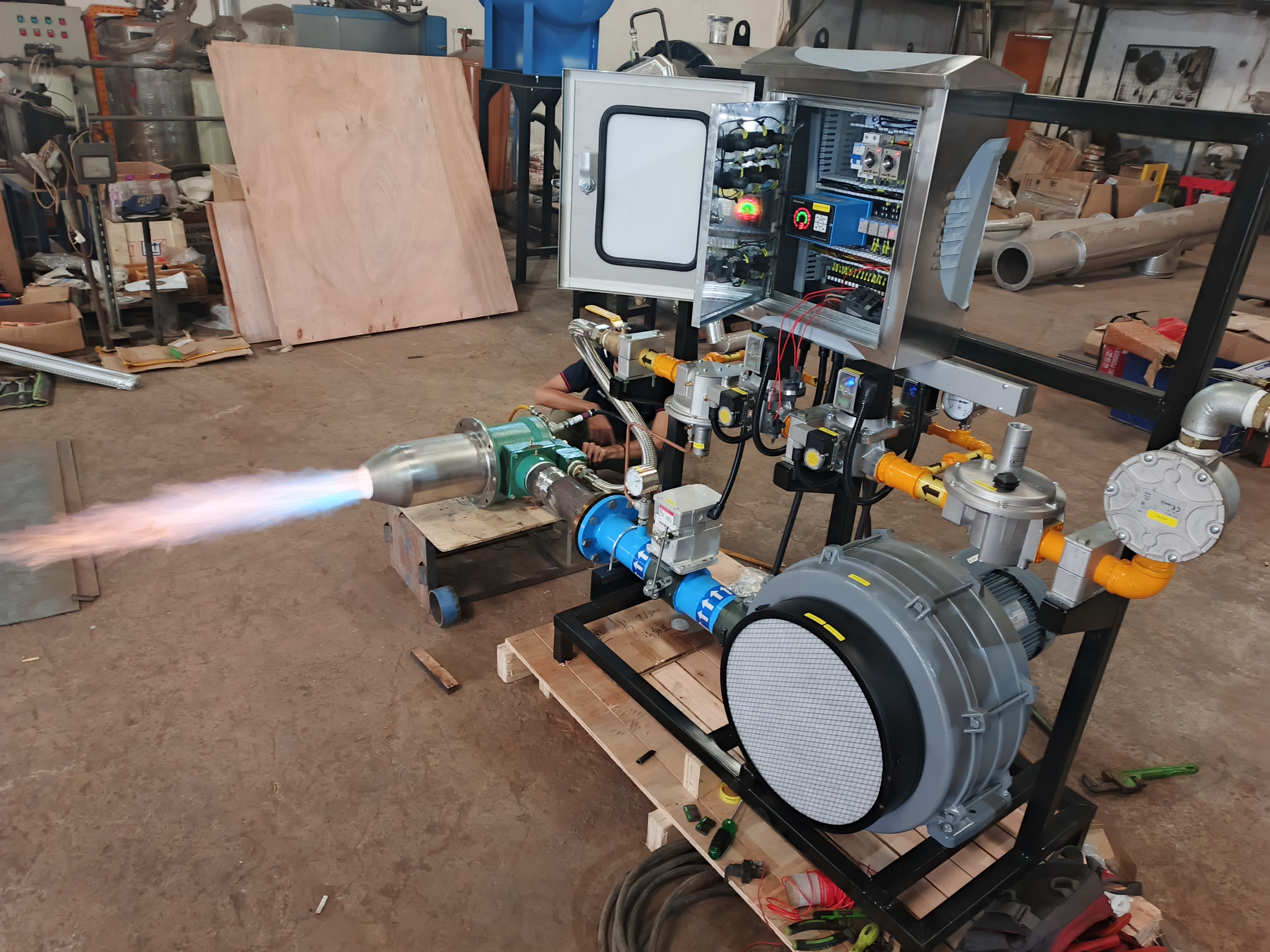
Our Gas Jet Burner System includes the following integrated components:
Burner Head Assembly – High-temperature stainless steel
High-Efficiency Blower – Delivers precise air-fuel ratio
Gas Train – Includes filters, regulators, pressure switches, and safety valves
Ignition Module – Electronic spark ignition with pilot burner
Flame Detector – UV/IR sensor for flame presence monitoring
Control Panel – Manual, Semi-Auto, or Fully Automatic (PLC optional)
Safety Interlocks – Automatic shutdown system in case of faults
This video showcases the Honeywell Eclipse ThermJet (TJ) Gas Burner, one of the world’s leading high-velocity industrial gas burner technologies, supplied and supported by PT Indira Mitra Boiler.
Throughout the video, viewers can observe the burner installation, ignition sequence, flame stabilization, combustion performance, and operating characteristics under industrial conditions. The demonstration highlights how the Eclipse ThermJet burner generates a high-velocity flame that provides rapid and uniform heat transfer while maintaining excellent combustion efficiency and low emissions.
The video also explains the major components of the burner system, including:
- High Velocity ThermJet Burner
- Combustion Air Blower
- Gas Train Assembly
- Gas Pressure Regulator
- Safety Shut-Off Valves
- Ignition Transformer
- Flame Detector (UV/Flame Rod)
- Burner Management System (BMS)
- PLC Control Panel
- Air/Gas Ratio Control
During operation, the burner demonstrates stable combustion with precise air-to-fuel ratio control, resulting in excellent flame stability over a wide modulation range. Honeywell Eclipse ThermJet burners are capable of operating with Natural Gas, LPG, Propane, and other clean gaseous fuels depending on burner configuration. They are well known for high flame velocity, low NOx emissions, and excellent temperature uniformity in industrial furnaces.
The video further illustrates how the burner is applied in various industrial heating systems, including:
- Heat Treatment Furnaces
- Reheating Furnaces
- Forging Furnaces
- Aluminum & Zinc Melting Furnaces
- Ceramic Kilns
- Glass Furnaces
- Thermal Oxidizers
- Rotary Dryers
- Industrial Ovens
- Steel Processing Lines
One of the major advantages demonstrated is the burner’s ability to produce an extremely high flame velocity, improving heat transfer efficiency and ensuring uniform furnace temperature distribution while reducing overall fuel consumption. ThermJet burners are designed with integrated air and gas orifices to simplify setup and provide reliable combustion performance.
PT Indira Mitra Boiler provides complete engineering services for Honeywell Eclipse burner systems, including:
- Engineering Design
- Burner Selection
- Gas Train Design
- Burner Management System (BMS)
- PLC & HMI Integration
- Mechanical Installation
- Electrical Installation
- Commissioning
- Combustion Tuning
- Preventive Maintenance
- Spare Parts Supply
- Technical Training
- After-Sales Support
For industrial combustion solutions, burner upgrades, retrofit projects, spare parts, and technical consultation, please contact:
PT Indira Mitra Boiler
📞 WhatsApp: 0813-8866-6204
Website: https://idmboiler.co.id
Website: https://burner.co.id
We provide complete combustion engineering solutions for boilers, furnaces, thermal oil heaters, industrial ovens, dryers, incinerators, and other industrial heating applications throughout Indonesia.
⚙️ Technical Specifications (Per Capacity Range)
Model | Thermal Capacity | Fuel Consumption | Air Requirement | Approx. Flame Length | Application |
|---|---|---|---|---|---|
| IMB-GJB-100 | 100 kW | ~10 Nm³/h (NG) | ~160 m³/h | ~0.5 – 0.7 meter | Small Boilers, Ovens |
| IMB-GJB-300 | 300 kW | ~30 Nm³/h | ~400 m³/h | ~0.8 – 1.2 meter | Dryers, Autoclaves |
| IMB-GJB-500 | 500 kW | ~50 Nm³/h | ~650 m³/h | ~1.2 – 1.5 meter | Steam Boilers |
| IMB-GJB-1000 | 1000 kW (1 MW) | ~100 Nm³/h | ~1200 m³/h | ~1.8 – 2.5 meter | Thermal Oil Heaters |
| IMB-GJB-2000 | 2000 kW (2 MW) | ~200 Nm³/h | ~2200 m³/h | ~2.5 – 3.5 meter | Hot Water Boilers |
| IMB-GJB-3000 | 3000 kW (3 MW) | ~300 Nm³/h | ~3200 m³/h | ~3.0 – 4.5 meter | Incinerators, Kilns |
| IMB-GJB-6000 | 6000 kW (6 MW) | ~600 Nm³/h | ~6000 m³/h | ~4.5 – 6.0 meter | Power Plant, Furnace |
Note: Above values are indicative. Final specs depend on application, fuel type (NG, LPG, biogas), altitude, and excess air settings.
✅ Key Features
Wide Modulation Range: 1:3 up to 1:10 turndown ratio
Multi-Fuel Capability: Natural Gas, LPG, Biogas
High Combustion Efficiency: Up to 95%
Low NOx / CO Emissions: Environmentally compliant
Flame Stability: Excellent flame holding across all loads
Control Options: On/Off, High-Low, Modulating, PLC + HMI
Smart Integration: SCADA-ready systems available
Application Sectors
️ Steam Boilers – Industrial processing
️ Thermal Oil Heaters – Palm oil mills, asphalt plants
Furnaces and Kilns – Metal, ceramics, glass
Dryers – Food, grains, biomass
Hot Water Generators – Hotels, laundries, central systems
♻️ Incinerators – Medical and industrial waste treatment
Installation & Services
PT Indira Mitra Boiler offers full lifecycle support:
System Design & Consultation
Supply & Fabrication
Installation & Testing
Burner Tuning & Combustion Optimization
Operator Training
Annual Maintenance Contracts (AMC)
Spare Parts & Upgrades
Included in Supply
✅ Burner Head and Housing
✅ Air Blower with Silencer
✅ Complete Gas Train (with piping & valves)
✅ Ignition System with Flame Detector
✅ Control Panel (Analog or Digital)
✅ User Manual & Documentation
✅ Installation Support & Commissioning
Why PT Indira Mitra Boiler?
Experienced Engineering Team – 10+ years in burner systems
️ Trusted Quality – Compliant with international safety standards
Performance-Oriented Design – Efficiency and reliability at the core
⚙️ Custom Solutions – Tailored burners for unique applications
Nationwide Support – Responsive service team across Indonesia
Case Study – Gas Jet Burner System for Industrial Furnace
Project Background
A metal processing manufacturer experienced unstable furnace temperatures, high natural gas consumption, and inconsistent product quality. The existing conventional gas burner produced an uneven flame pattern, causing localized overheating and cold spots inside the combustion chamber.
The production process required a stable operating temperature between 850°C and 950°C, while maintaining continuous operation for 24 hours per day. Frequent burner cycling also resulted in excessive wear on ignition components and increased maintenance costs.
To improve production efficiency and reduce operating expenses, the customer decided to replace the existing burner with a Gas Jet Burner System supplied and engineered by PT Indira Mitra Boiler.
Existing Operating Conditions
Parameter | Existing Burner |
|---|---|
| Fuel | Natural Gas |
| Thermal Capacity | 1,500 kW |
| Furnace Temperature | 830–970°C |
| Fuel Consumption | 155 Nm³/hour |
| Combustion Efficiency | 82% |
| Excess Oxygen | 8–10% |
| Flame Stability | Poor |
| Product Quality | Inconsistent |
| Burner Modulation | None |
The primary issues included:
- Unstable flame
- Uneven temperature distribution
- High excess air
- Increased fuel consumption
- Frequent ignition failures
- Higher maintenance frequency
Engineering Assessment
PT Indira Mitra Boiler conducted a complete combustion assessment, including:
- Heat load calculation
- Furnace volume analysis
- Gas supply pressure verification
- Airflow measurement
- Flue gas analysis
- Burner sizing
- Combustion CFD evaluation
- Safety interlock verification
The assessment revealed that the installed burner had an oversized flame diameter but insufficient flame penetration into the furnace.
Recommended Solution
A new Gas Jet Burner System was designed with:
- High-velocity jet flame
- Progressive modulating control
- Servo-controlled air damper
- Automatic air-fuel ratio control
- UV flame monitoring
- PLC-based burner management
- Complete gas train
- High-efficiency combustion blower
Installation Process
The retrofit included:
- Removal of the existing burner
- Furnace opening modification
- Installation of new burner assembly
- Gas train installation
- Control panel wiring
- Instrument calibration
- Burner tuning
- Safety testing
- Trial operation
- Performance verification
Commissioning was completed without interrupting the customer’s production schedule.
Performance After Installation
Parameter | Before | After |
|---|---|---|
| Thermal Efficiency | 82% | 93% |
| Fuel Consumption | 155 Nm³/h | 133 Nm³/h |
| Furnace Temperature Variation | ±70°C | ±10°C |
| Flame Stability | Poor | Excellent |
| Product Rejection | High | Low |
| Maintenance Frequency | Monthly | Quarterly |
| Ignition Reliability | Moderate | Excellent |
Operational Benefits
Following the installation of the Gas Jet Burner System, the customer achieved:
- Approximately 14–16% natural gas savings
- Improved furnace temperature uniformity
- Reduced oxidation of processed materials
- Better product consistency
- Lower maintenance costs
- Improved combustion safety
- Reduced burner downtime
- Faster furnace heat-up time
- Increased production capacity
- Longer equipment service life
Estimated Annual Savings
Assumptions:
- Natural Gas Cost = USD 0.40/Nm³
- Operating Hours = 8,000 hours/year
Fuel Saving
155 − 133 = 22 Nm³/hour
Annual Saving
22 × 8,000 = 176,000 Nm³/year
Annual Cost Saving
176,000 × USD 0.40
= USD 70,400 per year
Comparative Study – Gas Jet Burner System vs Conventional Industrial Burner
Industrial facilities often compare burner technologies based on thermal efficiency, operational reliability, maintenance costs, emissions, and total lifecycle cost.
Comparison | Conventional Burner | Gas Jet Burner System |
|---|---|---|
| Flame Stability | Moderate | Excellent |
| Air-Fuel Mixing | Basic | High Velocity Mixing |
| Combustion Efficiency | 80–86% | 90–95% |
| Fuel Consumption | Higher | Lower |
| Temperature Uniformity | Moderate | Excellent |
| Modulation Capability | Limited | Wide Turndown |
| Start-Up Time | Longer | Faster |
| Flame Response | Slow | Rapid |
| PLC Integration | Optional | Standard |
| Remote Monitoring | Limited | Available |
| Safety Interlock | Basic | Advanced |
| Maintenance | Frequent | Reduced |
| Operating Cost | Higher | Lower |
| NOx Emission | Higher | Lower |
| CO Emission | Higher | Lower |
| Lifetime Cost | Higher | Lower |
Combustion Performance Comparison
The Gas Jet Burner System generates a high-velocity flame that promotes rapid mixing between combustion air and fuel gas.
This enhanced mixing results in:
- Higher combustion efficiency
- Improved flame stability
- More uniform heat distribution
- Lower excess oxygen
- Reduced carbon monoxide formation
- Lower fuel consumption
Studies on industrial burners show that optimized burner geometry and enhanced mixing improve combustion quality while reducing emissions and increasing boiler or furnace efficiency.
Maintenance Comparison
A conventional burner typically requires frequent maintenance due to:
- Mechanical damper wear
- Flame instability
- Manual tuning
- Carbon deposits
- Repeated ignition failures
By comparison, the Gas Jet Burner System features automated combustion control, reducing maintenance requirements while improving long-term operational reliability.
Environmental Performance
Compared with conventional burners, a properly tuned Gas Jet Burner System can achieve:
- Lower NOx emissions
- Lower CO emissions
- Improved combustion completeness
- Reduced greenhouse gas emissions through lower fuel consumption
Advanced burner designs using optimized air-fuel mixing have demonstrated significant improvements in combustion efficiency and emissions performance in industrial applications.
Return on Investment
Although the initial investment for a Gas Jet Burner System may be higher than that of a conventional burner, most industrial users recover their investment within a relatively short period. Furthermore, lower fuel consumption significantly reduces operating costs. In addition, improved combustion efficiency minimizes heat losses and increases production capacity. Moreover, reduced maintenance requirements help decrease unexpected downtime and repair expenses. As a result, many facilities achieve a faster return on investment while improving overall operational reliability.
- Fuel savings
- Reduced maintenance
- Higher production efficiency
- Improved product quality
- Lower downtime
- Longer equipment life
For continuous industrial operations, the payback period commonly ranges from 12 to 24 months, depending on operating hours, fuel prices, and process conditions.
Get in Touch
Interested in our Gas Jet Burner system from 100 kW to 6000 kW? Contact us for a free consultation, site survey, or quotation.
PT Indira Mitra Boiler
Ratman Bejo
☎️✔081388666204
My Website
https://burnerstock.co.id
https://indira.co.id
Email: idmratman@gmail.com