Oil Heater Calculation is The best Manufactur PT Indira Mitra Boiler
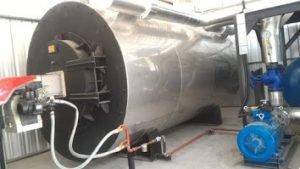
Thermal oil is designed horizontally and there is also a vertical design (standing).
Why Should You Choose a Thermal Oil Heater?
A Thermal Oil Heater (TOH) is an excellent choice for industrial process heating when high temperatures are required without the complexity and safety concerns associated with high-pressure steam systems. By circulating a specially formulated heat transfer oil in a closed-loop system, Thermal Oil Heaters deliver stable, efficient, and reliable heat for a wide range of industrial applications.
One of the greatest advantages of a Thermal Oil Heater is its ability to produce temperatures of up to 350°C or higher while operating at low pressure, often close to atmospheric pressure. Unlike steam boilers, which require high operating pressure to achieve elevated temperatures, Thermal Oil Heaters minimize the risks associated with pressure vessels and reduce regulatory and maintenance requirements.
The thermal oil continuously circulates through the closed system and is not consumed during operation. Under normal operating conditions, the oil does not evaporate or require frequent replacement. It only needs to be replenished if there is a system leak or after extended service life due to thermal degradation. This results in lower operating costs and improved process reliability.
High-Efficiency Heat Transfer
Inside the Thermal Oil Heater, fuel is burned in a specially designed combustion chamber using a high-efficiency burner. The combustion process generates hot flue gases that transfer heat to the thermal oil through two primary mechanisms:
- Radiant Heat Transfer
The thermal oil flowing through the spiral coils surrounding the combustion chamber first absorbs intense radiant heat directly from the flame. This section provides rapid and efficient heating of the oil. - Convective Heat Transfer
After leaving the radiant section, the hot combustion gases continue flowing through multiple convection passes. As the gases pass between the tightly arranged coils, additional heat is transferred to the circulating thermal oil by convection before the gases exit through the chimney.
Most modern Thermal Oil Heaters manufactured by PT Indira Mitra Boiler utilize a three-pass (3-pass) coil design, where the flue gas travels through three separate flow paths in the opposite direction of the thermal oil circulation. This counter-flow arrangement maximizes heat transfer efficiency, lowers exhaust gas temperatures, and extracts the maximum amount of usable energy from the fuel.
Key Advantages of Thermal Oil Heaters
- Operates at temperatures up to 350°C with low operating pressure.
- Eliminates steam generation, condensate return, and blowdown losses.
- Delivers highly stable and precise temperature control.
- Lower maintenance compared to conventional steam boiler systems.
- High thermal efficiency of up to 92–94% with optimized combustion.
- Reduced fuel consumption and operating costs.
- Closed-loop heat transfer system with minimal heat loss.
- Long service life with proper maintenance and high-quality thermal oil.
- Suitable for continuous industrial operation.
Applications
Thermal Oil Heaters are widely used in industries such as:
- Palm Oil Processing
- Asphalt Mixing Plants
- Chemical Processing
- Plastic Extrusion
- Rubber Manufacturing
- Textile Industry
- Food Processing
- Wood and Plywood Manufacturing
- Pharmaceutical Production
- Packaging Industry
- Tank Heating Systems
- Bitumen Heating
- Animal Feed Processing
Conclusion
Choosing a Thermal Oil Heater is a smart investment for industries requiring high-temperature process heating with maximum efficiency and reliability. Its low-pressure operation, closed-loop circulation system, superior heat transfer design, and reduced maintenance requirements make it an ideal alternative to conventional steam boilers. With advanced engineering, three-pass heat exchanger technology, and high-efficiency combustion systems, PT Indira Mitra Boiler provides Thermal Oil Heater solutions that deliver outstanding performance, lower fuel consumption, and long-term operational savings for industrial applications.
Thermal Oil as a Clean and Efficient Heat Transfer Medium
One of the major advantages of a Thermal Oil Heater is the use of thermal oil as the heat transfer medium. Unlike water in a steam boiler, thermal oil does not contain dissolved minerals that cause scale, corrosion, or fouling inside the heating coils and piping. As a result, the internal surfaces remain clean, maintaining high heat transfer efficiency throughout the system’s operating life.
Because there is no scale formation, Thermal Oil Heaters do not require the regular chemical cleaning and descaling procedures commonly associated with steam boilers. This significantly reduces maintenance costs, minimizes downtime, and extends the service life of the heating system.
Continuous Oil Circulation Protects the Heating Coil
The thermal oil is continuously circulated by a circulation pump through the heater and process equipment. This constant flow removes heat from the heating coils and distributes it evenly throughout the system, preventing localized hot spots that could damage the coils.
However, safe operation depends on maintaining the oil temperature within the recommended operating range. Excessive temperatures can accelerate thermal oil degradation, reduce heat transfer efficiency, and potentially shorten the life of the heater tubes. Therefore, overheating must always be prevented through a reliable control and safety system.
Advanced Safety and Temperature Control
A properly designed Thermal Oil Heater incorporates multiple layers of protection to ensure safe and reliable operation. Critical safety devices continuously monitor system conditions and automatically regulate burner operation.
Typical safety components include:
- High-temperature limit thermostat
- Process temperature controller
- Thermocouple or RTD temperature sensors
- Low thermal oil flow switch
- Burner flame safeguard controller
- Combustion air pressure switch
- Fuel pressure monitoring
- Emergency shutdown system
- Expansion tank level monitoring
The temperature controller (Thermocontrol) communicates with the thermocouple or RTD sensor to continuously monitor the outlet oil temperature. When the preset temperature is reached, the burner automatically modulates or shuts down, preventing overheating and protecting both the thermal oil and the heating coils.
A well-designed automatic control system reduces manual operator intervention while improving process stability, safety, and fuel efficiency.
High-Temperature Boiler Tubes for Maximum Reliability
Although a Thermal Oil Heater operates at relatively low pressure compared with a steam boiler, it is exposed to very high operating temperatures. For this reason, the heating coils and piping should be manufactured from high-quality boiler-grade seamless steel tubes specifically designed for elevated-temperature service.
Common materials include:
- ASTM SA-106 Grade B
- ASTM SA-178
- ASTM SA-192
- EN 10216 P235GH (depending on design requirements)
These materials provide excellent resistance to high temperatures, thermal stress, and long-term cyclic heating. Using thicker, high-quality boiler tubes improves durability, reduces the risk of tube failure, and increases the overall service life of the Thermal Oil Heater.
Benefits of Proper Thermal Oil Heater Design and Control
A properly engineered Thermal Oil Heater is more than just a heating system—it is a long-term investment in operational efficiency, safety, and reliability. By combining premium materials, optimized heat transfer design, and advanced automatic control technology, PT Indira Mitra Boiler delivers Thermal Oil Heater systems that maximize performance while minimizing operating costs.
No Scale or Mineral Deposits
Unlike steam boilers that use water as the heat transfer medium, Thermal Oil Heaters circulate specialized heat transfer oil. Because thermal oil contains no dissolved minerals, it does not produce scale, lime deposits, or corrosion inside the heating coils and piping. This keeps heat transfer surfaces clean and maintains consistent performance throughout the system’s service life.
Minimal Maintenance Requirements
The absence of scale and fouling eliminates the need for routine chemical cleaning, boiler blowdown, and water treatment systems. Maintenance is primarily limited to periodic inspection of the burner, circulation pump, filters, expansion tank, and safety devices, reducing maintenance costs and minimizing production downtime.
High Thermal Efficiency
The combination of a high-efficiency burner, optimized three-pass coil design, and superior insulation allows Thermal Oil Heaters to achieve thermal efficiencies of up to 92–94% under proper operating conditions. Clean heat transfer surfaces ensure that this efficiency remains stable over many years of operation.
Precise Temperature Control
Modern PLC- or microprocessor-based control systems continuously monitor oil temperature and automatically regulate burner output through modulating combustion control. This ensures stable outlet temperatures, prevents process fluctuations, improves product quality, and reduces unnecessary fuel consumption.
Lower Operating Costs
Higher combustion efficiency, reduced maintenance, elimination of water treatment, and the absence of steam losses all contribute to significantly lower operating expenses. Depending on the application, industries can achieve overall energy savings of 15–30% compared with conventional steam boiler systems.
Longer Equipment and Thermal Oil Life
Continuous circulation, proper temperature control, and the use of high-quality boiler-grade tubes minimize thermal stress on the heating coils. Preventing overheating also slows thermal oil degradation, extending both the oil replacement interval and the service life of the entire heating system.
Enhanced Operational Safety
Although Thermal Oil Heaters operate at relatively low pressure, safety remains a critical design priority. Multiple protection devices—including high-temperature limit thermostats, low-flow switches, flame safeguard systems, pressure monitoring, and emergency shutdown controls—work together to protect the equipment and ensure safe operation under all conditions.
Reliable Continuous Operation
Designed for 24-hour industrial service, Thermal Oil Heaters provide stable and uninterrupted heat for demanding manufacturing processes. Their consistent temperature control and dependable performance make them suitable for industries such as food processing, chemical manufacturing, palm oil, plastics, asphalt, textiles, pharmaceuticals, and many other high-temperature applications.
Key Benefits at a Glance
- Clean heat transfer system with no scale or mineral buildup.
- No routine descaling, blowdown, or chemical water treatment.
- High thermal efficiency of up to 92–94%.
- Accurate automatic temperature control for consistent process quality.
- Reduced fuel consumption and lower operating costs.
- Extended service life of both thermal oil and heating equipment.
- Comprehensive safety protection with advanced control systems.
- Durable boiler-grade heating coils designed for high-temperature operation.
- Reliable, continuous industrial heating with minimal downtime.
- Lower total cost of ownership throughout the equipment’s lifecycle.
By integrating robust mechanical design with intelligent combustion and temperature control, PT Indira Mitra Boiler manufactures Thermal Oil Heater systems that deliver maximum efficiency, outstanding reliability, and long-term value for industrial process heating.
Study Case: Thermal Oil Heater Efficiency Calculation – The Best Manufacturer PT Indira Mitra Boiler
Thermal Oil Heater Efficiency Calculation
Thermal Oil Heater is an industrial heating system designed to transfer thermal energy using a special heat transfer fluid (thermal oil) instead of water or steam. The thermal oil circulates through spiral coils installed inside the heater where it absorbs heat generated by the burner. The heated oil is then pumped through a closed-loop piping system to deliver stable and uniform heat to industrial equipment.
Unlike steam boilers that are limited by water saturation temperatures, thermal oil systems can safely operate at temperatures above 300°C while maintaining relatively low operating pressure. This makes Thermal Oil Heaters an ideal solution for industries requiring high-temperature process heating with improved safety and energy efficiency.
PT Indira Mitra Boiler has supplied Thermal Oil Heater systems for various industries in Indonesia including food processing, asphalt plants, palm oil, chemical processing, textile, plywood, rubber, packaging, pharmaceutical, and manufacturing industries.
Why Choose Thermal Oil Heater Instead of Steam Boiler?
Many factories still use steam boilers because they are familiar and widely available. However, not every industrial process requires steam.
Steam boilers generate saturated steam containing moisture with operating temperatures generally between 170°C and 200°C, depending on pressure.
Thermal Oil Heaters circulate hot oil instead of steam, allowing process temperatures of 250°C–350°C without operating under high pressure.
This provides several important advantages:
- Lower operating pressure
- No steam loss
- No condensate return system
- No blowdown losses
- Stable temperature control
- Lower maintenance costs
- Higher thermal efficiency
For industries requiring only heat—not steam—a Thermal Oil Heater is generally the more economical and efficient solution.
Study Case
Customer Requirement
A plastic manufacturing company requires continuous heating for an extrusion production line.
Process Data
| Item | Value |
|---|---|
| Required Heat Load | 1,000,000 kcal/hr |
| Operating Temperature | 280°C |
| Operating Hours | 20 Hours/Day |
| Fuel | Natural Gas |
| Burner Efficiency | 98% |
| Thermal Oil Heater Capacity | 1,000,000 kcal/hr |
Efficiency Calculation – Study Case
| Step | Description | Calculation | Result |
|---|---|---|---|
| 1 | Useful Heat Output Required process heat. | QOutput | 1,000,000 kcal/hr |
| 2 | Combustion Energy Required Thermal Oil Heater Efficiency = 92% | Fuel Energy = Useful Heat ÷ Efficiency = 1,000,000 ÷ 0.92 | 1,086,957 kcal/hr |
| 3 | Natural Gas Consumption Heating Value = 8,500 kcal/Nm³ | 1,086,957 ÷ 8,500 | 127.9 Nm³/hr Rounded = 128 Nm³/hour |
| 4 | Daily Fuel Consumption Operating Time = 20 Hours/Day | 128 × 20 | 2,560 Nm³/day |
| 5 | Annual Fuel Consumption Operating 300 Days/Year | 2,560 × 300 | 768,000 Nm³/year |
| 6 | Annual Fuel Cost Natural Gas Price = Rp7,500/Nm³ | 768,000 × Rp7,500 | Rp5,760,000,000/year (≈ Rp5.76 Billion/year) |
| Parameter | Value |
|---|---|
| Useful Heat Output | 1,000,000 kcal/hr |
| Fuel Heat Input | 1,086,957 kcal/hr |
Heat Loss Analysis
| Energy Distribution | Value |
|---|---|
| Useful Heat to Thermal Oil | 1,000,000 kcal/hr |
| Total Fuel Energy Input | 1,086,957 kcal/hr |
| Heat Loss | 86,957 kcal/hr |
| Thermal Efficiency | 92% |
| Total Heat Loss | 8% |
Why PT Indira Mitra Boiler Achieves High Efficiency
PT Indira Mitra Boiler Thermal Oil Heaters are engineered to achieve efficiencies of 92–94% through:
- Optimized three-pass spiral coil heat exchanger design.
- High-efficiency gas, diesel, or dual-fuel burners.
- Fully automatic modulating combustion control.
- Large radiant and convection heat transfer surfaces.
- High-density ceramic fiber and rockwool insulation to minimize heat loss.
- Optimized flue gas flow for maximum heat recovery.
- Precision temperature control for stable and efficient operation.
By combining advanced combustion technology with optimized heat exchanger design, PT Indira Mitra Boiler Thermal Oil Heaters deliver high thermal efficiency, lower fuel consumption, reduced operating costs, and reliable long-term performance across a wide range of industrial heating applications.
Comparison with Conventional Steam Boiler
For the same process heat requirement of 1,000,000 kcal/hr, the Thermal Oil Heater requires less fuel energy than a conventional steam boiler due to its higher thermal efficiency.
| Parameter | Steam Boiler | Thermal Oil Heater |
|---|---|---|
| Useful Heat Output | 1,000,000 kcal/hr | 1,000,000 kcal/hr |
| Thermal Efficiency | 82% | 92% |
| Fuel Energy Required | 1,219,512 kcal/hr | 1,086,957 kcal/hr |
| Natural Gas Consumption | 143.5 Nm³/hr | 128 Nm³/hr |
Fuel Saving Comparison
| Item | Value |
|---|---|
| Steam Boiler Gas Consumption | 143.5 Nm³/hr |
| Thermal Oil Heater Gas Consumption | 128 Nm³/hr |
| Fuel Saving | 15.5 Nm³/hr |
| Fuel Saving Percentage | ≈10.8% |
Additional Energy Savings
Besides higher combustion efficiency, a Thermal Oil Heater eliminates many energy losses commonly found in conventional steam boiler systems.
| Energy Loss Source | Steam Boiler | Thermal Oil Heater |
|---|---|---|
| Blowdown Heat Loss | Yes | None |
| Condensate Return Loss | Yes | None |
| Flash Steam Loss | Yes | None |
| Steam Trap Loss | Yes | None |
| Water Treatment Cost | Required | Not Required |
| Feed Water Pump Energy | High | Low |
| Start-up Time | Longer | Faster |
| Temperature Stability | Moderate | Excellent |
| Overall Energy Saving | Baseline | 15–30% |
| Steam Boiler Loss | Thermal Oil Heater |
|---|---|
| Blowdown Loss | None |
| Condensate Loss | None |
| Flash Steam Loss | None |
| Steam Trap Loss | None |
| Water Treatment Energy | Minimal |
| Feed Water Pump Energy | Lower |
| Boiler Start-up Time | Faster |
| Heat Stability | Excellent |
These advantages typically result in overall operational energy savings of 15–30%, depending on the application and existing steam system performance.
Why PT Indira Mitra Boiler Thermal Oil Heater Is More Efficient
PT Indira Mitra Boiler designs its Thermal Oil Heater systems with several efficiency-enhancing features:
- Three-pass spiral coil design for maximum heat transfer.
- High-efficiency gas, diesel, or dual-fuel burners.
- Fully automatic PLC-based combustion control.
- Modulating burner operation to match process demand.
- High-density ceramic fiber and rockwool insulation to minimize heat loss.
- Optimized combustion chamber geometry for complete fuel combustion.
- Premium heat transfer coils designed for long service life.
- Variable-speed circulation pump options for optimized energy consumption.
- Stable outlet oil temperature with precise control.
Industries Suitable for Thermal Oil Heater
PT Indira Mitra Boiler supplies Thermal Oil Heater systems for:
- Palm Oil Processing
- Edible Oil Refinery
- Asphalt Mixing Plant
- Chemical Industry
- Plastic Extrusion
- Rubber Processing
- Wood & Plywood
- MDF Board
- Textile Industry
- Food Processing
- Pharmaceutical Industry
- Animal Feed Plant
- Packaging Industry
- Printing Industry
- Bitumen Heating
- Tank Heating System
Conclusion
For industrial applications that require high-temperature process heating without the need for steam, a Thermal Oil Heater offers significant technical and economic advantages over a conventional steam boiler. In this study case, a 1,000,000 kcal/hr Thermal Oil Heater operating at 92% efficiency consumes approximately 128 Nm³/hour of natural gas, compared with 143.5 Nm³/hour for a typical 82% efficient steam boiler. This represents a direct fuel saving of approximately 10.8%, with total operational savings potentially reaching 15–30% when reduced blowdown, condensate losses, water treatment, and maintenance are considered.
PT Indira Mitra Boiler designs and manufactures high-efficiency Thermal Oil Heater systems engineered for long service life, precise temperature control, low operating costs, and reliable performance, making them an ideal solution for modern industrial process heating across a wide range of industries.
Workshop
Kawasan Pergudangan Laksana Business Park, Jalan Laksana 6 Blok F 09, Desa laksana Kec. Pakuhaji, Kab. Tangerang, Banten- 15570
PT Indira Mitra Boiler
Ratman Bejo
☎️081388666204
My Website
https://indira.co.id
Email: info@indira.co.id
Email: idmratman@gmail.com
https://www.youtube.com/@Ratman_Bejo/videos