Boiler Boiler (Steam Boiler)
Marine Steam Boiler
A marine steam boiler, also called a ship boiler, produces steam for heating, cleaning, auxiliary equipment, and propulsion systems. The boiler heats treated feedwater until it turns into pressurized steam.
Marine boilers can use fuel oil, diesel oil, natural gas, LNG, or electricity. In addition, some systems recover heat from the main engine exhaust gas. Nuclear-powered vessels may also use steam for propulsion; however, this application remains limited to specialized naval vessels.
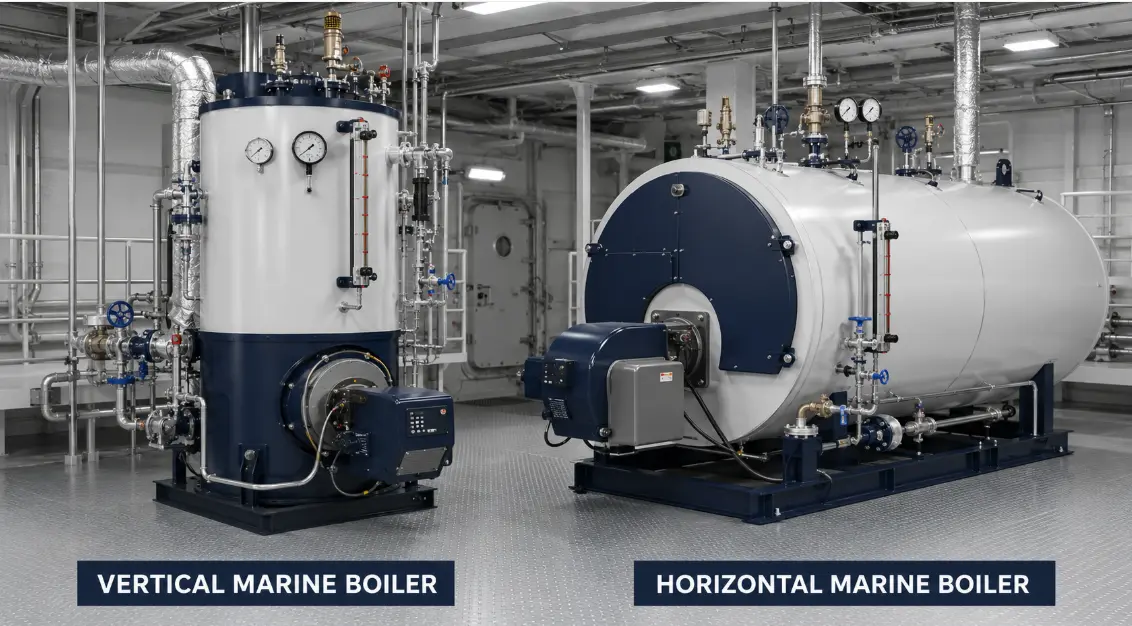
Marine Boiler Applications on Ships
The main function of a marine boiler is to provide a reliable steam supply for ship operations. For example, steam can heat heavy fuel oil before the engine or burner uses it.
Furthermore, marine steam supports cargo heating, tank cleaning, freshwater production, accommodation heating, and deck machinery. On certain vessels, high-pressure steam also drives the main or auxiliary steam turbine.
The boiler transfers heat from combustion or engine exhaust gas into the feedwater. As a result, the water reaches its boiling point and produces steam.
Afterward, the steam separator removes water droplets before the system sends steam into the main distribution line. Therefore, the equipment receives steam with the quality and pressure required for safe operation.
Functions of Boilers on Ships
A marine boiler can supply steam for the following applications:
- Heating heavy fuel oil
- Heating lubricating oil
- Maintaining cargo temperature
- Cleaning cargo tanks
- Producing domestic hot water
- Operating cargo pump turbines
- Supporting freshwater generators
- Heating accommodation spaces
- Operating steam tracing systems
- Driving main or auxiliary steam turbines
However, not every vessel uses steam for its main propulsion. Most modern motor ships use diesel or dual-fuel engines as their main power source. Instead, these ships operate auxiliary, exhaust-gas, or composite boilers to meet their heating and service demands.
Marine Boiler for Fuel Heating
Heavy fuel oil has a high viscosity at low temperatures. Therefore, the ship must heat it before pumping, purification, and injection.
Steam can heat the fuel inside storage tanks, settling tanks, service tanks, and fuel lines. Consequently, the fuel reaches the correct viscosity for efficient combustion.
Marine Boiler for Tank Cleaning
Oil and chemical tankers use steam or steam-heated water to clean their cargo tanks. First, the cleaning system sprays hot water onto the tank surfaces. Then, heat loosens and removes the remaining cargo.
In addition, steam can support stripping and preparation before inspection. Tank cleaning creates a high temporary steam demand; therefore, engineers must include this load when selecting the boiler capacity.
Marine Boilers for Steam Turbines
High-pressure steam can drive marine turbines connected to propulsion systems, electrical generators, or cargo pumps. However, a propulsion boiler has a different design and operating capacity from a standard auxiliary boiler.
A marine propulsion boiler produces a large volume of high-pressure steam to operate the ship’s main steam turbine. Meanwhile, an auxiliary boiler supplies steam for fuel heating, cargo systems, tank cleaning, domestic hot water, and other ship services.
How a Marine Propulsion Boiler Works
A marine boiler converts treated feedwater into pressurized steam. To complete this process, the boiler operates together with several supporting components, including:
- Feedwater tank
- Feedwater pump
- Burner and combustion system
- Steam drum
- Superheater
- Economizer
- Air preheater
- Safety valve
- Pressure and water-level controller
- Main steam line
- Condensate return system
First, the feedwater pump sends treated water into the boiler. At the same time, the burner mixes fuel with combustion air and produces heat inside the furnace.
Next, the boiler transfers heat through the furnace wall and tube surfaces. As a result, the water reaches its boiling point and turns into steam.
The steam drum then separates water droplets from the steam. Afterward, the superheater raises the steam temperature above its saturation point before the main steam line delivers it to the turbine.
Inside the turbine, high-pressure steam expands across several turbine stages. This expansion rotates the turbine shaft and produces mechanical power. Finally, the turbine transfers that power to the propeller, generator, or cargo pump.
Image caption: Working principle of a marine boiler and steam turbine propulsion system.
Marine Steam Turbine Applications
Marine steam turbines can perform several functions on board:
- Driving the main ship propeller
- Operating electrical generators
- Driving tanker cargo pumps
- Operating boiler feedwater pumps
- Driving compressors
- Supporting other high-power auxiliary equipment
Main propulsion turbines require a continuous supply of high-quality steam. Therefore, the boiler control system must maintain stable pressure, temperature, water level, and steam flow.
Propulsion Boiler Versus Auxiliary Boiler
| Parameter | Propulsion Boiler | Auxiliary Boiler |
|---|---|---|
| Main function | Drives the main steam turbine | Supplies steam for ship services |
| Steam capacity | Very large | Small to medium |
| Operating pressure | High | Low to medium |
| Steam condition | Often superheated | Usually saturated |
| Main consumers | Propulsion turbine and generator | Fuel heaters, cargo systems, and accommodation |
| Operating pattern | Continuous during propulsion | Depends on service demand |
| Control complexity | High | Relatively moderate |
| Typical design | Water tube boiler | Fire tube, water tube, or composite boiler |
A propulsion boiler must respond reliably to changes in vessel speed and turbine load. In contrast, an auxiliary boiler responds to heating and service demands throughout the ship.
Role of Marine Boilers in Fuel Heating
A ship boiler also supports the fuel system of the main engine. Large marine engines may use heavy fuel oil, which becomes thick and difficult to pump at low temperatures.
If the fuel viscosity remains too high, the system may experience:
- Poor pumping performance
- Increased pressure loss
- Filter blockage
- Incomplete purification
- Poor injector atomization
- Incomplete combustion
- Carbon deposits
- Black exhaust smoke
Therefore, the fuel system must heat heavy fuel oil before pumping, purification, and engine injection.
Why Ships Use Steam to Heat Fuel
Ships must not apply an open flame directly to a fuel tank. Instead, steam from the auxiliary boiler flows through closed heating coils inside the tank.
The steam transfers heat through the coil wall without contacting the fuel. Consequently, the fuel temperature increases while its viscosity decreases.
Marine fuel-heating systems may use steam in:
- Fuel storage tanks
- Settling tanks
- Service tanks
- Fuel oil heaters
- Purifier preheaters
- Fuel transfer pipes
- Steam-tracing lines
After releasing heat, the steam condenses into water. Steam traps then discharge the condensate and return it to the feedwater system when the installation allows condensate recovery.
Marine Fuel Heating Process
The fuel-heating process generally follows these stages:
- The storage tank receives and stores heavy fuel oil.
- Steam coils maintain the fuel at a pumpable temperature.
- A transfer pump sends the fuel to the settling tank.
- Heating helps separate water and solid contaminants.
- A purifier removes water and impurities from the fuel.
- The service tank stores the treated fuel.
- A final steam heater adjusts the fuel viscosity.
- A booster pump sends the heated fuel to the engine.
- The injector atomizes the fuel inside the combustion chamber.
Operators should control the fuel according to the viscosity required by the engine manufacturer. A fixed temperature alone may not provide the correct viscosity for every fuel grade.
Importance of Steam Quality
Marine propulsion turbines require clean, dry, and properly superheated steam. Water droplets inside the steam flow can damage turbine blades, reduce efficiency, and cause erosion.
Therefore, the boiler system may use:
- Steam separators
- Superheaters
- Temperature controllers
- Drum-level controls
- Feedwater treatment
- Chemical dosing
- Continuous blowdown
- Steam purity monitoring
Auxiliary heating systems also benefit from dry steam because it transfers heat efficiently and reduces water hammer inside the distribution piping.
Conclusion
Marine boilers provide steam for propulsion turbines, generators, cargo pumps, fuel heating, and other essential ship systems. Propulsion boilers produce large quantities of high-pressure steam, while auxiliary boilers focus on heating and service applications.
In addition, steam allows ships to heat heavy fuel oil without exposing the fuel to a direct flame. This controlled heating process lowers fuel viscosity, improves pumping and atomization, and helps the main engine operate efficiently.
Therefore, proper boiler selection must consider steam capacity, pressure, temperature, fuel type, vessel operation, and the requirements of every connected steam consumer.
Marine Steam Boiler: Functions, Applications, Comparison, and Case Study
A marine steam boiler, also known as a ship boiler, is equipment used to convert treated feedwater into pressurized steam. The generated steam provides thermal energy or mechanical power for various systems installed on board a ship.
Depending on the boiler design and vessel requirements, the heat source may come from:
- Marine diesel oil
- Heavy fuel oil
- Natural gas or LNG
- Dual-fuel combustion
- Biomass on specialized vessels
- Electricity
- Exhaust gas from the main engine
- Nuclear energy on certain military vessels
Modern commercial ships generally use oil-fired, gas-fired, electric, exhaust-gas, or composite marine boilers.
Marine Boiler Applications on Ships
The primary function of a marine boiler is to generate steam for propulsion, heating, cleaning, and auxiliary ship operations.
On steam-powered vessels, high-pressure steam may drive a steam turbine connected to the main propulsion system. However, most modern motor ships use diesel or dual-fuel engines for propulsion and operate smaller auxiliary boilers for their heating requirements.
Steam produced by a marine boiler can be used for:
- Heating heavy fuel oil
- Heating lubricating oil
- Heating cargo oil
- Operating fuel oil purifiers
- Tank cleaning
- Cargo tank heating
- Steam tracing
- Galley and accommodation services
- Freshwater generation
- Soot blowing
- Deck machinery
- Cargo pump turbines
- Inert gas system support
- Main or auxiliary steam turbines
The exact steam demand depends on the vessel type, cargo, engine configuration, operating route, and ambient conditions.
How Does a Marine Steam Boiler Work?
A marine boiler transfers heat from fuel combustion or engine exhaust gas into treated feedwater.
The operating sequence generally includes:
- Feedwater is collected inside the hotwell or feedwater tank.
- A feedwater pump sends water into the boiler.
- The burner mixes fuel with combustion air.
- The ignition system starts the combustion process.
- Heat is transferred through the furnace and boiler tubes.
- Boiler water reaches its boiling point and produces steam.
- The steam is separated from water inside the steam space or drum.
- Dry steam is distributed through the main steam header.
- Condensate from the process is returned to the feedwater system.
- Safety and control devices regulate pressure, water level, and burner operation.
In an exhaust-gas boiler, heat from the main engine exhaust replaces or reduces the use of burner fuel.
Main Functions of Boilers on Ships
Marine Fuel Heating
Heavy fuel oil must be heated to reduce its viscosity before purification, pumping, and injection into the engine or burner.
Steam can be used to heat:
- Fuel storage tanks
- Settling tanks
- Service tanks
- Fuel oil heaters
- Fuel transfer lines
- Fuel oil purifiers
Correct steam pressure and temperature control are important because excessive heating may degrade the fuel or create unsafe operating conditions.
Cargo Oil Heating
Oil and chemical tankers may require steam to maintain cargo temperature and viscosity. Steam flows through heating coils installed inside the cargo tanks, while condensate is returned through steam traps.
Cargo heating helps:
- Maintain pumpable viscosity
- Prevent cargo solidification
- Reduce unloading time
- Maintain the specified transportation temperature
Tank Cleaning
Tankers use steam or steam-heated water for cargo tank cleaning. The system removes oil residues before loading a different cargo or performing inspection and maintenance.
Boiler capacity must be sufficient to handle the temporary peak steam demand created by tank-cleaning machines.
Steam Turbine Operation
On steam turbine ships, high-pressure and high-temperature steam can drive the main propulsion turbine. Steam may also operate auxiliary turbines connected to cargo pumps, generators, or other machinery.
A propulsion boiler is considerably larger and operates at higher pressure than a typical auxiliary boiler.
Hotel and Domestic Services
Marine steam can supply heating for accommodation spaces, kitchens, laundry equipment, calorifiers, and hot-water systems. These loads are usually smaller but must remain available while the ship is in port.
Types of Marine Boilers
Fire Tube Marine Boiler
In a fire tube boiler, combustion gas flows through tubes surrounded by water. Heat passes through the tube walls and converts the surrounding water into steam.
Fire tube boilers are commonly selected for low- to medium-pressure auxiliary services.
Advantages include:
- Simple construction
- Stable steam pressure
- Relatively straightforward maintenance
- Good steam storage capacity
- Suitable for moderate steam loads
Limitations include:
- Longer start-up time
- Larger water content
- Slower response to sudden load changes
- Higher weight for the same output
Water Tube Marine Boiler
In a water tube boiler, water flows inside the tubes while hot combustion gas passes around them. This arrangement allows operation at higher pressure and steam capacity.
Advantages include:
- Rapid steam generation
- Higher pressure capability
- Faster response to load changes
- Lower water content
- Suitable for propulsion and large steam demands
Limitations include:
- More complex construction
- Higher feedwater-quality requirements
- Greater sensitivity to scale and contamination
- More demanding inspection and maintenance
Exhaust Gas Boiler
An exhaust gas boiler recovers waste heat from the main engine exhaust to produce steam without continuously burning additional fuel.
Its advantages include:
- Reduced fuel consumption
- Recovery of waste heat
- Lower operating costs
- Reduced exhaust energy losses
However, steam production decreases when the main engine operates at low load or stops. Therefore, an auxiliary source of steam may still be required.
Composite Boiler
A composite boiler combines an oil-fired section and an exhaust-gas section in one unit.
While the vessel is sailing, engine exhaust gas produces steam. When the vessel is in port or the engine load is insufficient, the oil-fired burner supplies the required heat.
This configuration provides operational flexibility while reducing fuel consumption at sea.
Electric Marine Boiler
An electric marine boiler uses heating elements instead of a combustion burner. It does not require a fuel system or combustion chimney for normal operation.
Electric boilers provide:
- Clean operation at the point of use
- Accurate pressure control
- Low noise
- Simple start-up
- Reduced burner maintenance
Comparison of Marine Boiler Types
Parameter | Fire Tube | Water Tube | Exhaust Gas | Composite | Electric |
|---|---|---|---|---|---|
| Main energy source | Oil or gas | Oil or gas | Engine exhaust | Exhaust and fuel | Electricity |
| Pressure capability | Low to medium | Medium to high | Usually low to medium | Low to medium | Low to medium |
| Start-up time | Relatively slow | Fast | Depends on engine load | Flexible | Fast |
| Water content | High | Low | Varies | Varies | Relatively low |
| Fuel consumption | Moderate | Depends on load | Very low directly | Lower at sea | No direct fuel combustion |
| Load response | Moderate | Fast | Depends on exhaust heat | Good | Very fast |
| Construction | Simple | More complex | Heat-recovery system | Combined construction | Relatively simple |
| Typical application | Auxiliary services | Propulsion and high loads | Steam production at sea | General merchant ships | Port and low-load services |
Auxiliary Boiler Versus Propulsion Boiler
| Parameter | Auxiliary Boiler | Propulsion Boiler |
|---|---|---|
| Primary purpose | Heating and ship services | Main propulsion |
| Steam capacity | Relatively small | Very large |
| Operating pressure | Low to medium | High |
| Main consumer | Fuel heaters, tanks, cleaning systems | Main steam turbine |
| Operation | At sea and in port | During vessel propulsion |
| Burner capacity | Small to medium | Very large |
| System complexity | Moderate | High |
Case Study: Auxiliary Boiler for an Oil Tanker
An oil tanker requires steam for fuel heating, cargo tank heating, tank cleaning, and accommodation services.
The estimated simultaneous steam consumption is:
| Steam Consumer | Required Steam |
|---|---|
| Fuel oil heating | 700 kg/h |
| Cargo heating | 1,800 kg/h |
| Tank cleaning | 900 kg/h |
| Domestic services | 200 kg/h |
| Piping and operating losses | 300 kg/h |
| Total demand | 3,900 kg/h |
After applying a 15% design margin:
3,900×1.15=4,485 kg/h3,900 \times 1.15 = 4,485\text{ kg/h}
A practical boiler selection would be approximately 4,500–5,000 kg/h, subject to verification of load simultaneity, steam pressure, feedwater temperature, cargo requirements, and redundancy philosophy.
A composite boiler may be suitable because it can recover exhaust heat while the vessel is sailing and use its burner while the vessel is in port.
Case Study: Composite Boiler for a Cargo Ship
A cargo ship requires an average of 1,200 kg/h of steam while sailing. The main engine exhaust gas can generate approximately 900 kg/h under normal sea conditions.
The remaining steam requirement is:
1,200−900=300 kg/h1,200-900=300\text{ kg/h}
A composite boiler can use recovered exhaust heat as the primary energy source and operate its burner only when the recovered heat is insufficient.
The system may provide the following benefits:
- Lower fuel consumption at sea
- Automatic support during reduced engine load
- Steam availability while the ship is in port
- A smaller installation footprint than two separate boilers
- Improved use of waste heat
Actual savings must be determined from the main engine exhaust flow, exhaust temperature, sailing profile, boiler efficiency, and annual operating hours.
Case Study: Electric Boiler During Port Operation
A vessel needs 300 kg/h of steam while berthed for fuel conditioning and domestic hot-water services. Operating a large auxiliary boiler at a very low firing rate could produce cycling and standby losses.
An electric boiler may be considered if sufficient shore power or generator capacity is available.
The comparison should include:
- Available electrical capacity
- Shore electricity tariff
- Generator fuel consumption
- Auxiliary boiler minimum firing rate
- Port emission restrictions
- Expected port operating hours
An electric boiler may offer cleaner and quieter port operation. However, it will only be economical if the electrical supply and operating profile support its use.
Marine Boiler Safety Systems
A marine boiler should be equipped with appropriate control and protection systems, including:
- Low-water alarm
- Low-low water burner trip
- High-water alarm
- High steam-pressure cutout
- Safety valve
- Flame-failure protection
- Fuel-pressure protection
- Combustion-air pressure switch
- Furnace purge sequence
- Feedwater control
- Pressure gauge
- Water-level gauge
- Emergency stop
- Automatic burner management system
The final design must comply with the applicable marine classification society, flag-state requirements, boiler design standard, and vessel specification.
Conclusion
A marine steam boiler supports propulsion, fuel heating, cargo heating, tank cleaning, domestic services, and other essential ship operations. The appropriate boiler type depends on steam capacity, operating pressure, engine configuration, fuel availability, vessel type, and sailing profile.
Fire tube boilers are practical for moderate auxiliary steam loads, whereas water tube boilers are better suited to higher pressures and rapidly changing demand. Meanwhile, exhaust-gas and composite boilers can improve energy utilization by recovering waste heat from the main engine.
Correct boiler selection should be based on a complete steam-load calculation rather than nominal capacity alone. PT Indira Mitra Boiler provides engineering support, boiler selection, fabrication, installation, burner commissioning, and marine heating-system services according to project requirements.
PT Indira Mitra Boiler
Office: (021) 352 95874
WhatsApp: +62 813-8866-6204 (Ratman Bejo)
www.indiramitraboiler.co.id
www.burner.co.id
info@indira.co.id
idmratman@gmail.com
Workshop: Tangerang – Indonesia
https://www.youtube.com/@Bejoburnerindonesia